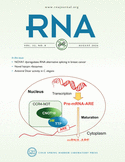
Table of Contents

November 2012; 18 (11)

HYPOTHESIS

  • In this paper, the authors explore the possibility that the base-pairing strength of miRNA–mRNA target plays a role in microRNA-mediated gene regulation. The authors found a significant correlation between the physiological temperature of the organism and the average G/C content of its miRNAs. This study suggests that an organism adapts its miRNA–target free energy according to its physiological temperature, thus highlighting the importance of base-pairing strength in miRNA activity.

ARTICLES

  • Eukaryotic releasing factor GSPT/eRF3 mediates translation termination-coupled mRNA decay via interaction with a cytosolic poly(A)-binding protein (PABPC1). A region of eRF3 containing two overlapping PAM2 (PABPC1-interacting motif 2) motifs is assumed to bind to the PABC domain of PABPC1, on the poly(A) tail of mRNA. PAM2 motifs are also found in the major deadenylases Caf1–Ccr4 and Pan2–Pan3, whose activities are enhanced upon PABPC1 binding to these motifs. Their deadenylase activities are regulated by eRF3, in which two overlapping PAM2 motifs competitively prevent interaction with PABPC1. However, it is unclear how these overlapping motifs recognize PABC and regulate deadenylase activity in a translation termination-coupled manner. The authors used a dominant-negative approach to demonstrate that the N-terminal PAM2 motif is critical for eRF3 binding to PABPC1 and that both motifs are required for function.

  • RNA-binding proteins that target mRNA coding regions are emerging as regulators of post-transcriptional processes in eukaryotes. Here the authors describe a newly identified RNA-binding protein, RBP42, which targets the coding region of mRNAs in the insect form of the African trypanosome, Trypanosoma brucei. RBP42 is an essential protein and associates with polysome-bound mRNAs in the cytoplasm. By use of HITS-CLIP, target RNA sequences were identified and quantified using high-throughput RNA sequencing. Analysis revealed that RBP42 bound mainly within the coding region of mRNAs that encode proteins involved in cellular energy metabolism. It is therefore possible that RBP42 plays a critical role in modulating T. brucei energy metabolism.

  • Stem–loop II of U1 snRNA and Stem–loop IV of U2 snRNA typically have 10 or 11 nucleotides in their loops. The fluorescent nucleobase 2-aminopurine was used as a substitute for the adenines in each loop to probe the local and global structures and dynamics of these unusually long loops. Using steady-state and time-resolved fluorescence, the authors find that, while the bases in the loops are stacked, they are able to undergo significant local motion on the picosecond/nanosecond timescale. In addition, the loops have a global conformational change at low temperatures that occurs on the microsecond timescale, as determined using laser T-jump experiments. Nucleobase and loop motions are present at temperatures far below the melting temperature of the hairpin stem, which facilitates the conformational change required for protein binding to these RNA loops.

  • Nuclear cap binding protein complex (CBC) is a heterodimer of a small subunit (Cbc2 in yeast) that binds the m7G cap and a large subunit (Sto1 in yeast) that interacts with karyopherins. In order to probe the role of cap recognition in yeast CBC function, the authors introduced alanine mutations (Y24A, F91A, D120A, D122A, R129A, and R133A) and N-terminal deletions (NΔ21 and NΔ42) in the cap-binding pocket of Cbc2. Whereas the effects of weakening CBC–cap interactions are buffered by other actors in the splicing pathway during yeast mitotic growth, the NΔ42 allele causes a severe impediment to yeast sporulation and meiosis. These studies reveal a new level of splicing control during meiosis that is governed by nuclear CBC.

  • MicroRNAs play central roles in controlling gene expression in human cells. Sequencing data show that many miRNAs are produced at different levels and as multiple isoforms that can vary in length at their 5′ or 3′ ends, but the biogenesis and functional significance of these RNAs are largely unknown. The authors show here that the human trans-activation response (TAR) RNA binding protein (TRBP), a known molecular partner of the miRNA processing enzyme Dicer, changes the rates of pre-miRNA cleavage in an RNA-structure-specific manner. Furthermore, TRBP can trigger the generation of iso-miRNAs (isomiRs) that are longer than the canonical sequence by one nucleotide. They show that this change in miRNA processing site can alter guide strand selection, resulting in preferential silencing of a different mRNA target. These results implicate TRBP as a key regulator of miRNA processing and targeting in humans.

  • A detailed functional analysis of the CRISPR-associated Thermus thermophilus Cas5d protein identifies it as a sequence-specific pre-crRNA processing endonuclease. High-resolution X-ray structural studies of a second Cas5d ortholog highlight similarities with previously characterized CRISPR processing enzymes. A combination of structural and functional analyses based on these results allow a modeling of the interaction of Cas5d with its RNA substrate and suggest that it is a member of a larger conserved family of CRISPR RNA endonucleases.

  • Cells infected with arthropod-borne flaviviruses (e.g., Dengue or Kunjin viruses) accumulate uncapped mRNAs or viral genomes, decay intermediates normally targeted by cellular 5′-to-3′ exonuclease XRN1. These viruses also generate a short noncoding RNA (sfRNA) from the viral 3′ untranslated region during infection, due to the stalling of the XRN1. This paper shows that XRN1 can be found associated with sfRNA during infection and that this results in the repression of its activity. Cellular mRNAs are also stabilized by sfRNA, likely as a result of the shutdown of the 5′-to-3′ mRNA decay pathway.

  • MicroRNAs (miRNAs) are regulators of gene expression affecting a great variety of biological processes. A variety of mechanisms have been proposed to explain the mechanism by which miRNAs act to repress gene expression. Here, the authors propose an alternative catalytic model of microRNA-mediated repression. They show that miRNAs are present in large excess over the concentrations of Argonaute (Agos) proteins in HeLa cells, implying the existence of miRNA–mRNA duplexes not bound by Agos. This is in contrast to the consensus view that all miRNAs are associated with Argonaute proteins. The authors also developed a novel application of fluorescence lifetime imaging microscopy (FLIM) that allows them to directly visualize Ago binding to preformed microRNA–mRNA duplexes in live cells.

  • Germline small RNAs called Piwi-interacting RNAs (piRNAs) silence transposable elements to provide genome protection. Tudor domain-containing 1 (TDRD1) is an interaction partner of mouse Piwi proteins and is implicated in piRNA biogenesis. The authors provide biochemical support for a model where only Tudor domains 2–4 of TDRD1 are effective in binding methylated ligands from a mouse Piwi protein MILI. Crystal structure of the third Tudor domain, in complex with a methylated MILI peptide, reveals how a symmetrically dimethylated arginine is recognized by the aromatic cage within the Tudor domain, while additional contacts with nonmethylated residues stabilize the interactions. SAXS analysis of the four tandem Tudor domains reveals an elongated, flexible structure that supports a molecular scaffold role for TDRD1, where it allows assembly of complexes containing Piwi proteins and piRNA biogenesis factors.

  • Epstein-Barr virus (EBV)–infected cells express two noncoding RNAs called EBV-encoded RNA (EBER) 1 and EBER2. Despite their high abundance in the nucleus (about 106 copies), the molecular function of these noncoding RNAs has remained elusive. Here, the authors report that the insertion into EBER1 of an RNA aptamer that binds the bacteriophage MS2 coat protein allows the isolation of EBER1 and associated protein partners. By combining MS2-mediated selection with stable isotope labeling of amino acids in cell culture (SILAC) and analysis by mass spectrometry, they identified AUF1 (AU-rich element binding factor 1)/hnRNP D (heterogeneous nuclear ribonucleoprotein D) as an interacting protein of EBER1. Given the high abundance of EBER1 in EBV-positive cells, EBER1 may disturb the normal homeostasis between AUF1 and ARE-containing mRNAs or compete with other AUF1-interacting targets in cells latently infected by EBV.

  • This paper provides a thorough analysis of factors influencing Dicer substrate selectivity. Although there has been a body of work in the literature concerning the requirements for Dicer cleavage, this study represents a large-scale analysis of the sequence and structure requirements of pre-miRNA substrates. The authors combine in vitro Dicer cleavage and binding assays to show that human Dicer tolerates structural variations in its pre-miRNA substrates. Interestingly, the extent of Dicer binding to its pre-miRNA substrate cannot fully explain the differential dicing activities. A large terminal loop further enhances pre-miRNA cleavage.

  • The spliceosomal branch site adenosine of the yeast Saccharomyces cerevisiae, which functions as the nucleophile in the first step of pre-mRNA splicing, adopts an extrahelical conformation in the presence of a phylogenetically conserved pseudouridine (ψ) modification in the U2 snRNA strand. Here, using NMR and fluorescence techniques, the authors show that this extrahelical motif also requires a purineU2 strand-pyrimidineintron strand base pair two residues 5′ to the extrahelical adenosine, with which it forms a base triple between the amino group of the adenosine and the pair's minor groove edge. In addition, they show that the fluorescent adenine analog 2-aminopurine, in which the amino group is in a different location, also adopts an extrahelical conformation, suggesting that the position is not solely dependent upon hydrogen bond formation.