


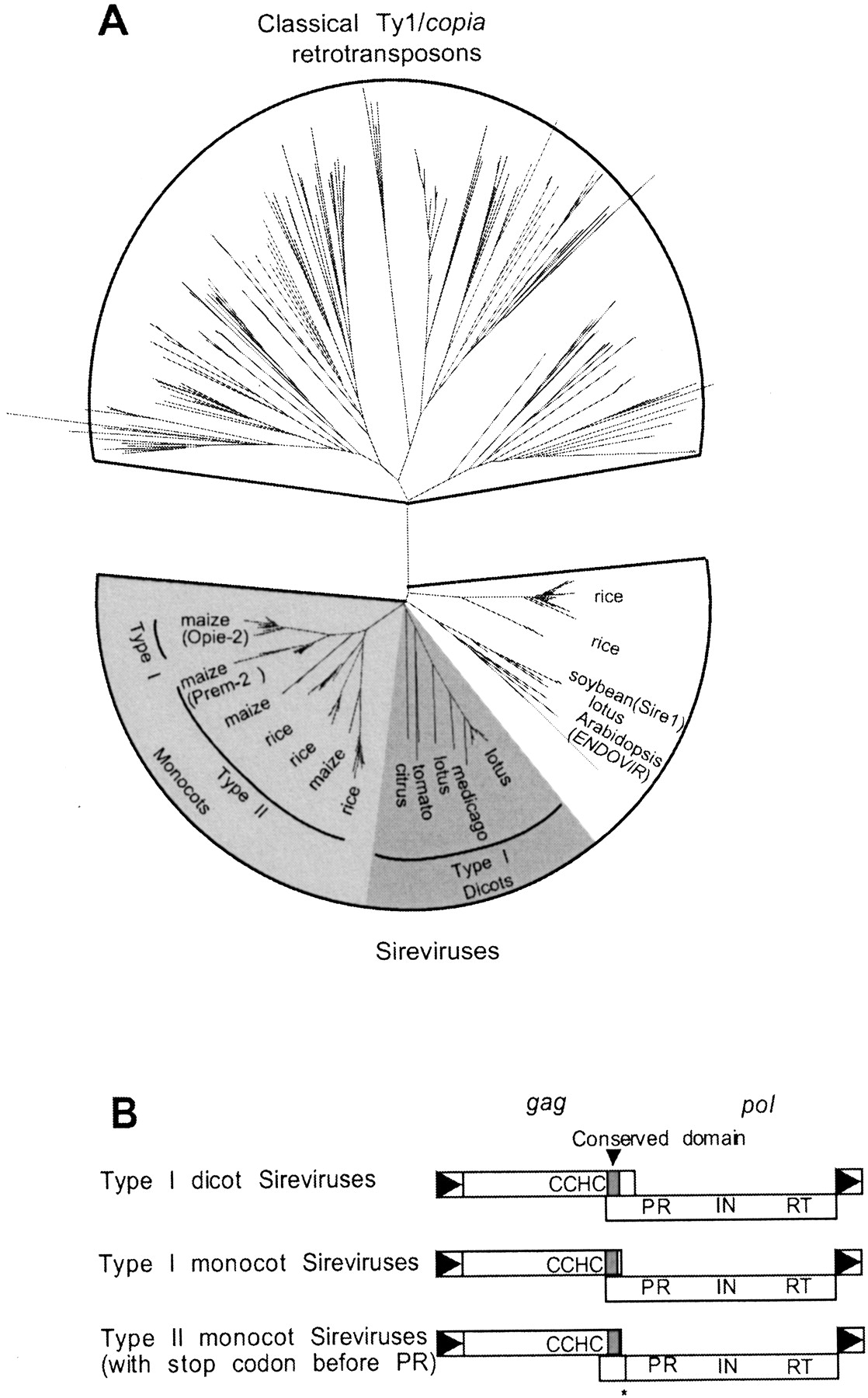
Unusual organization of gag and pol among Sireviruses. (A) Phylogenetic relationships of Ty1/copia retroelements. The top part of the tree depicts classical Ty1/copia retrotransposons (Pseudoviruses and Hemiviruses). Based on branch lengths, Sireviruses are more closely related than classical Ty1/copia retroelements, suggesting they recently colonized their host genomes. Retrotransposons in shaded areas have a potential frameshift between gag and pol. Host names for Sireviruses are labeled at the ends of branches, and the names in parentheses denote annotated retroelements in the core data set. (B) The ORF structure of retrotransposons in the shaded regions depicted in A. Only those elements with separate gag and pol reading frames have the conserved sequence motif. Type II elements in monocots likely utilize an unusual translation mechanism because a stop codon (asterisk) exists at the beginning of pol. A gag zinc finger (CCHC) and the protease active site of pol (PR) flank the conserved nucleotide motif in the frameshift region. (RT) reverse transcriptase; (IN) integrase.




