


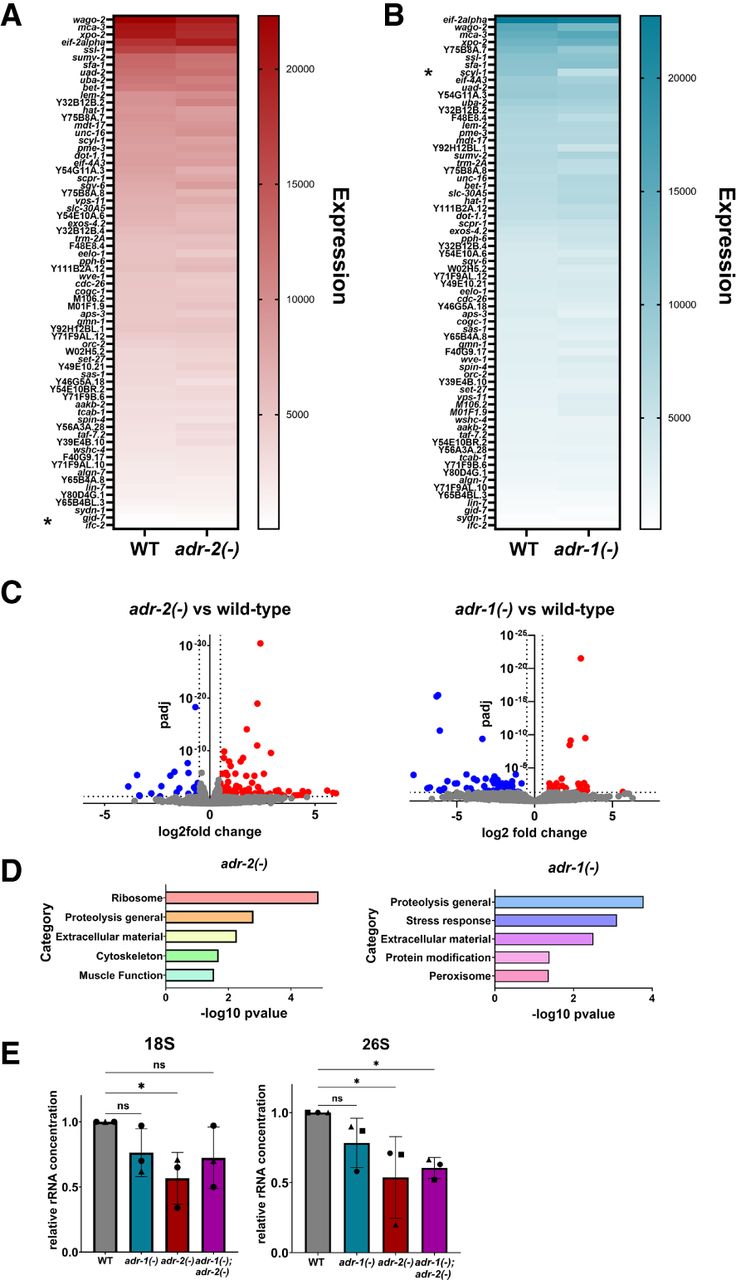
ADARs regulate germline gene expression. (A,B) Expression of edited genes in adr-2(-) germlines compared to control (WT) germlines (A) and adr-1(-) germlines compared to control (WT) germlines (B). Data represent expression values from DESeq analysis averaged across three biological replicates. (*) Significant change in expression (Padj ≤ 0.05, log2 fold change ≥0.05). (C) Differentially expressed genes in adr-2(-) germlines compared to wild type (left) and adr-1(-) germlines compared to wild type (right). Gray points denote genes with no significant change in expression, red points denote significantly upregulated genes (Padj ≤ 0.05, log2 fold change ≥0.5), and blue points denote significantly downregulated genes (Padj ≤ 0.05, log2 fold change ≤0.5). Two outlying genes were left out of adr-2(-) figure for scale: adr-2 (log2 fold change = −6.13, Padj = 2.23 × 10−241) and cls-3 (log2 fold change = 3.77, Padj = 1.40 × 10−123). (D) Gene ontology analysis of genes misregulated in adr-2(-) germlines compared to wild type (left) and adr-1(-) germlines compared to wild type (right). (E) TapeStation measurements of 18S and 26S rRNA in wild-type, adr-1(-), adr-2(-), and adr-1(-);adr-2(-) germlines. rRNA concentrations are normalized to a spike-in RNA of known concentration. Data represent three biological replicates. Significance determined via one-way ANOVA, (ns) P > 0.05, (*) P ≤ 0.05.




