


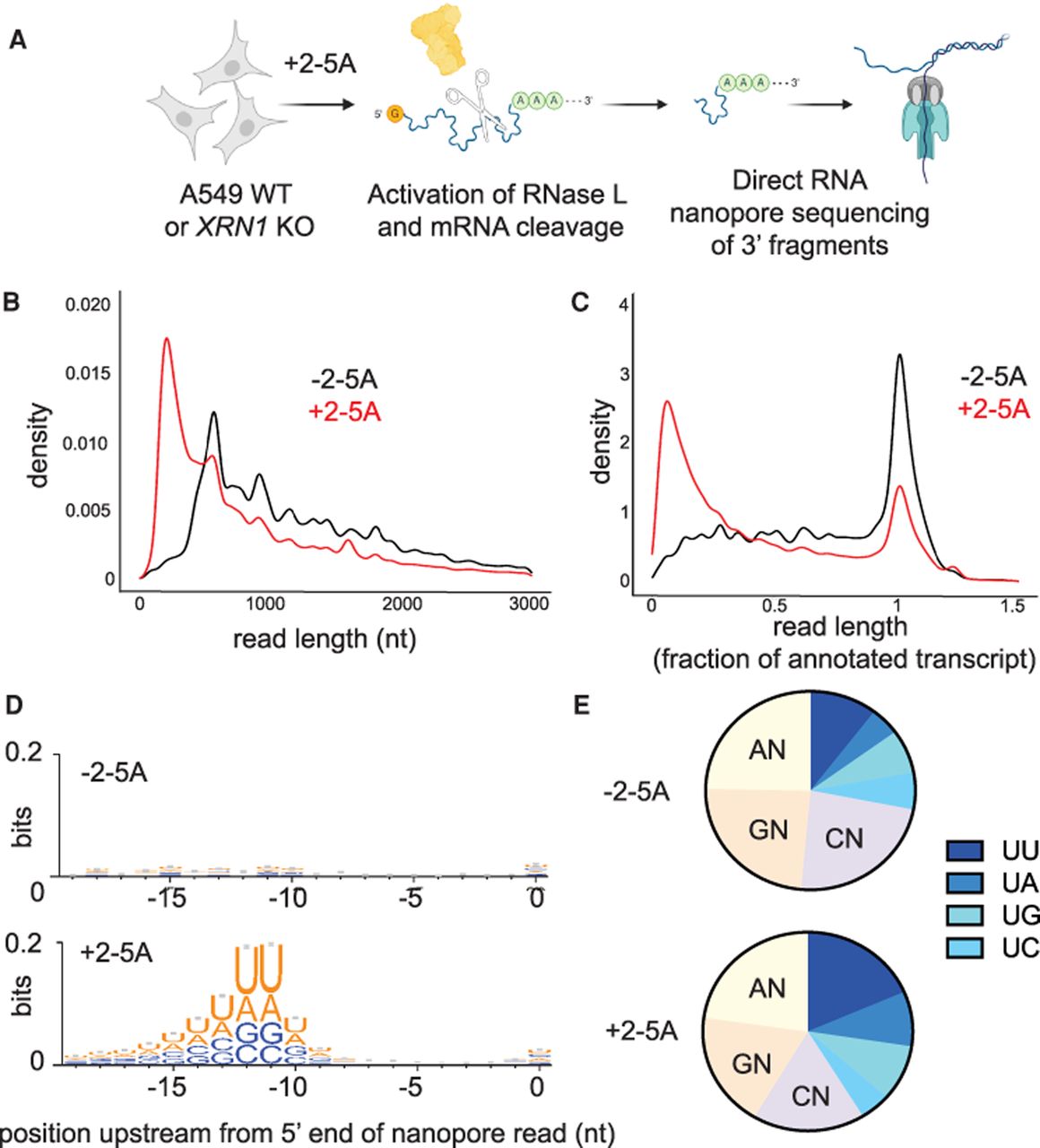
RNase L 3′ cleavage products are detectable after RNase L activation. (A) Schematic representation of direct RNA nanopore sequencing experiments. A549 cells were transfected with 5 µM of 2-5A for 4.5 h, and then total RNA was extracted. RNase L 3′ cleavage products and uncleaved mRNA that contain poly(A) were sequenced. (B) Length distribution of nanopore direct sequencing reads in 2-5A treated (+2-5A) and control (−2-5A) samples in XRN1 KO cells. (C) Normalized length distribution of nanopore direct sequencing reads to their respective annotated reference transcript in 2-5A treated (+2-5A) and control (−2-5A) samples in XRN1 KO cells. (D) WebLogo analysis shows enrichment of U bases in transcriptome positions just upstream of where nanopore sequencing stopped in ±2-5A treated XRN1 KO cells. (E) Dinucleotide motif distribution near the 5′ end of 3′ fragments in ±2-5A treated XRN1 KO cells (−11 to −12 positions to account for RNA left in pore after sequencing stops). The number of total fragments were 212,139 (−2-5A) and 1,012,615 (+2-5A). In both D and E, 3′ fragments were defined as reads that were shorter than a third of their respective annotated transcript.




