


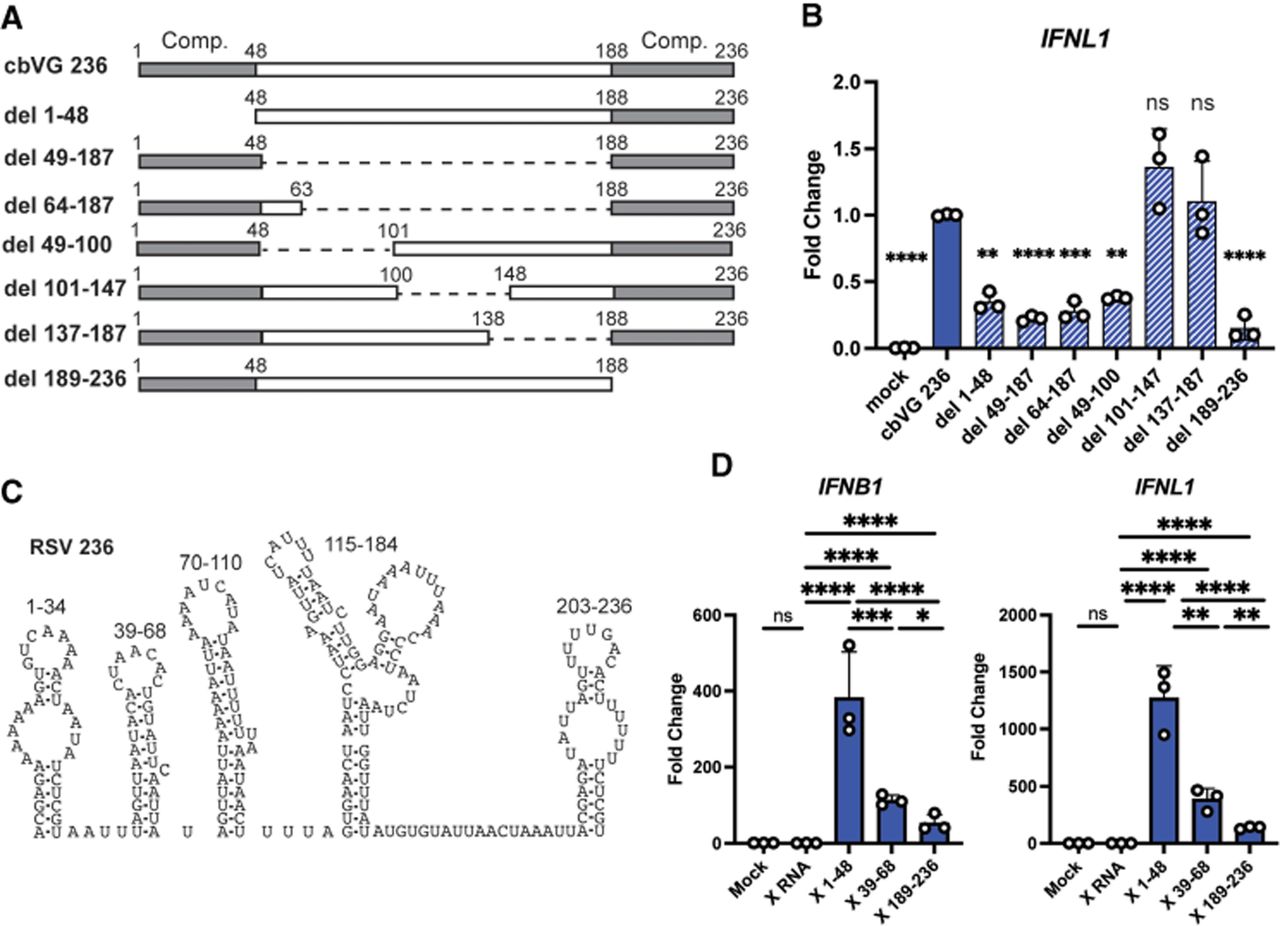
RSV cbVG sequences 1–48 and 39–68 are immunostimulatory. (A) Indicated deletion versions of RSV cbVG 236 were generated by in vitro transcription, then 1 pmol of IVT RNA was transfected into A549 cells. Gray boxes represent complementary regions (Comp.) of the cbVG. (B) Expression of IFNL1 was measured by qPCR at 6 hpt. One-way ANOVA with Tukey's HSD post hoc test was performed for statistical analysis. (ns) P > 0.05, (**) P < 0.01, (***) P < 0.001, (****) P < 0.0001. Data are represented as fold change over cbVG 236. (C) Predicted structure of RNA stem–loops from RSV cbVG 236. (D) Sequences from RSV cbVG 236 were attached to X RNA and then in vitro transcribed. One picomole of RNA was transfected into A549 cells, and expression of IFNB1 and IFNL1 was measured by qPCR at 6 hpt. One-way ANOVA with Tukey's HSD post hoc test was performed for statistical analysis. (ns) P > 0.05, (*) P < 0.05, (**) P < 0.01, (***) P < 0.001, (****) P < 0.0001. Data are represented as fold change over the X RNA control. Data reported are biological triplicates.




