


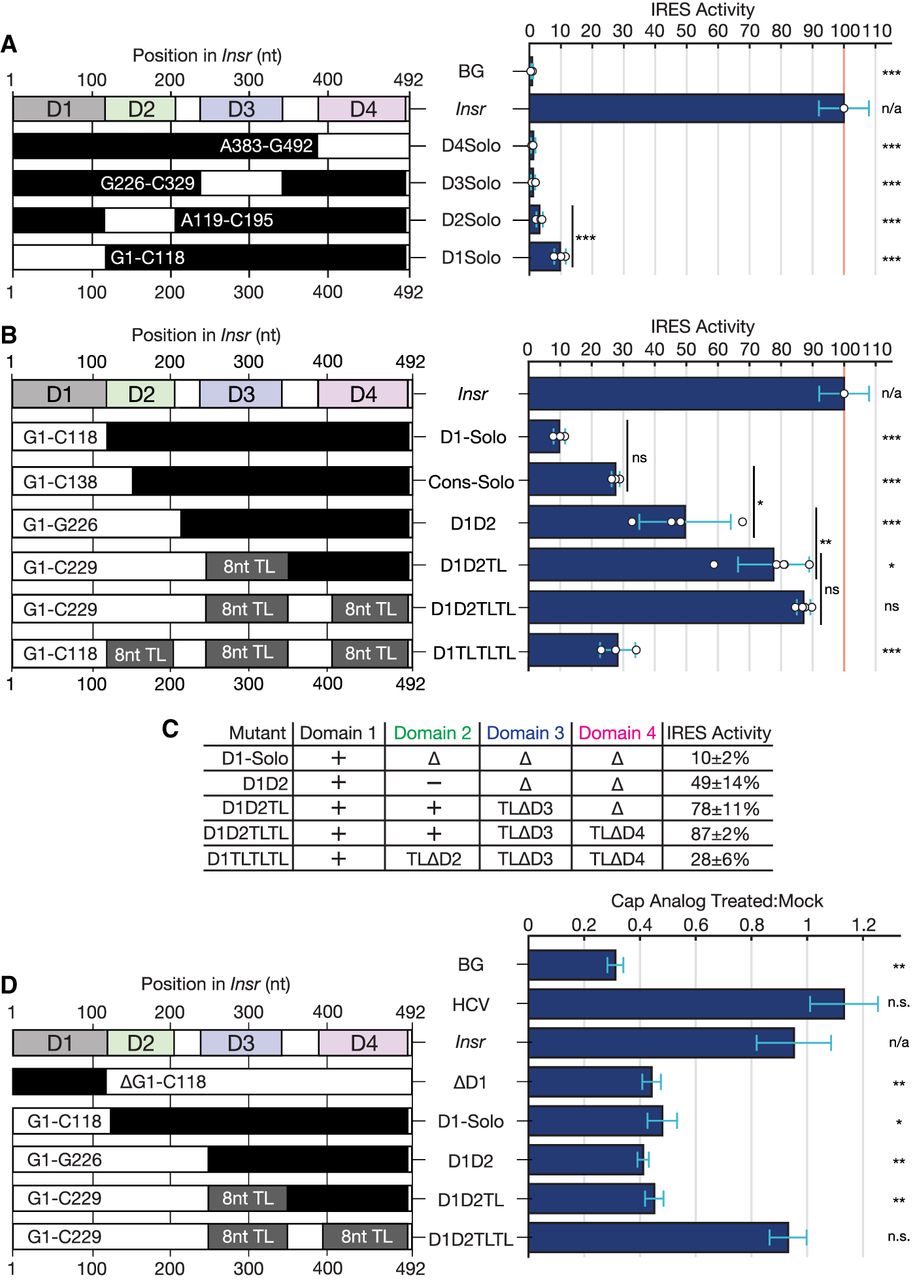
Creating a minimal sufficient Insr 5′UTR IRES. (A) Bicistronic luciferase reporter results on each domain individually with metrics and statistics, as previously described. The positions of retained UTR are specified for each mutant here and in subsequent subfigures. (B) Bicistronic luciferase reporters’ performance on sufficiency mutants with UTR or generic TL hairpin replacements added back until sufficiency is achieved. D1-Solo is the same data as in A, included for comparison. (C) Summary of the activity results in A and B combined with structure probing of these assayed UTRs in a monocistronic context (see Materials and Methods). Δ: Deletion, TL: tetraloop hairpin, +: intact structure, −: disrupted structure. (D) At bottom, sufficiency mutants assayed by monocistronic luciferase reporters with in vitro translation in rabbit reticulocyte lysate (RRL) challenged with m7G cap analog. Bars plot the ratio of signal between cap-treated and mock reactions to show the susceptibility of each UTR to excess cap analog (see Materials and Methods). For this experiment, n = 2. Error bars: average standard deviation from technical replicates.




