


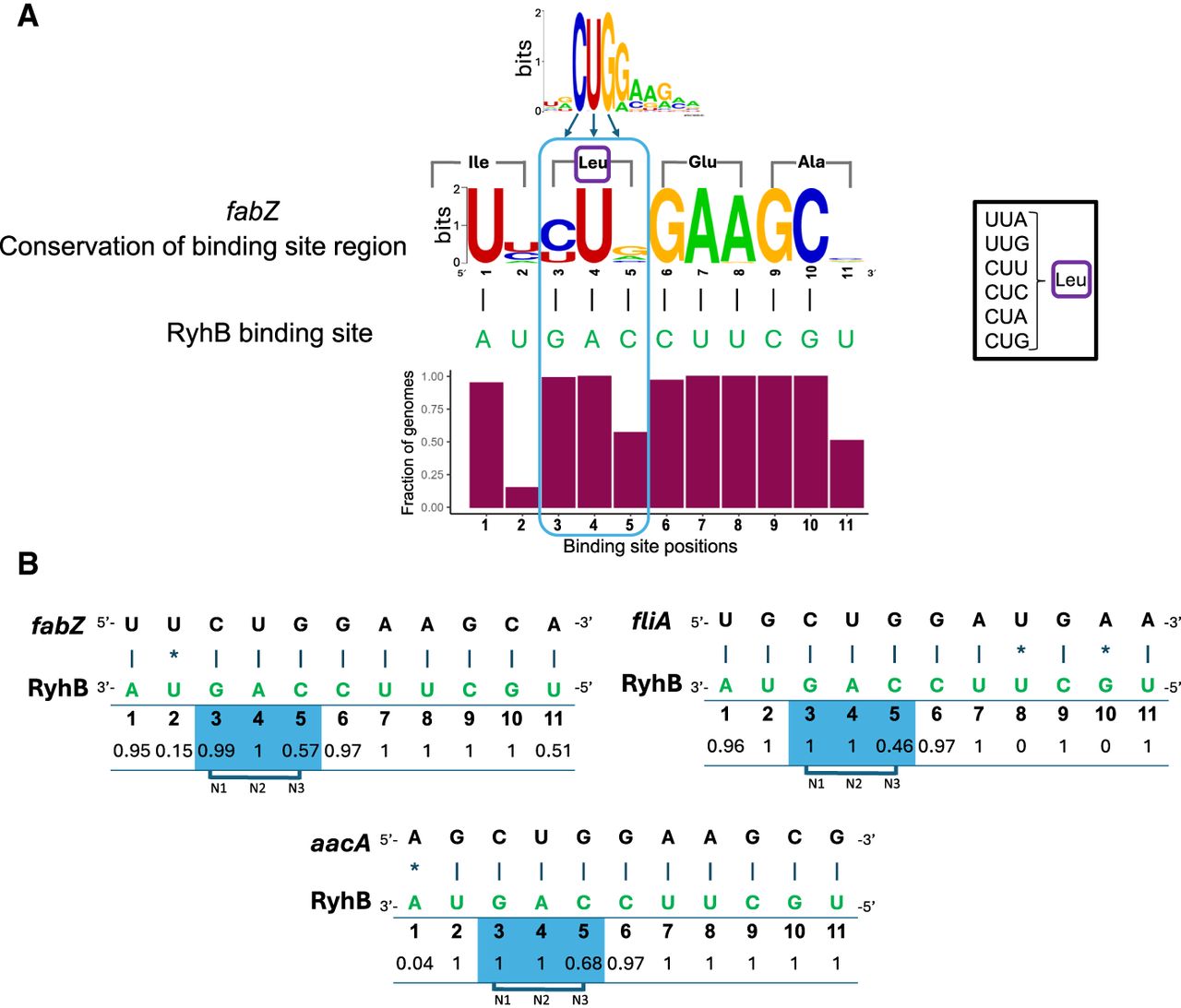
Conservation of base-pairing interactions between an sRNA and its targets. (A) Conservation is exemplified by fabZ–RyhB base-pairing interactions. At the top is the logo of RyhB binding sites based on E. coli targets (Melamed et al. 2016). Conservation of RyhB binding site across the different genomes (except for Enterobacteriaceae) is presented below in bits of information, computed based on equal frequency of the four bases. The logo representation was generated using WebLogo (http://weblogo.berkeley.edu/logo.cgi). Blue arrows mark the prime positions, and the reading frame and encoded amino acids are marked as well. RyhB binding site is shown below in green. The black lines represent base-pairing between the RyhB and fabZ nucleotides. The height of the bars below represents the fraction of genomes in which the positional base-pairing could be fulfilled. On the right, the six codons encoding Leu are shown. (B) Examples of conservation of positional base-pairing in RyhB–target interactions. Shown below each base pair is the fraction of genomes in which this putative base pair interaction could be fulfilled. The reading frame corresponding to the dominant alignment of the prime positions of RyhB binding site is marked (N1, N2, N3).




