


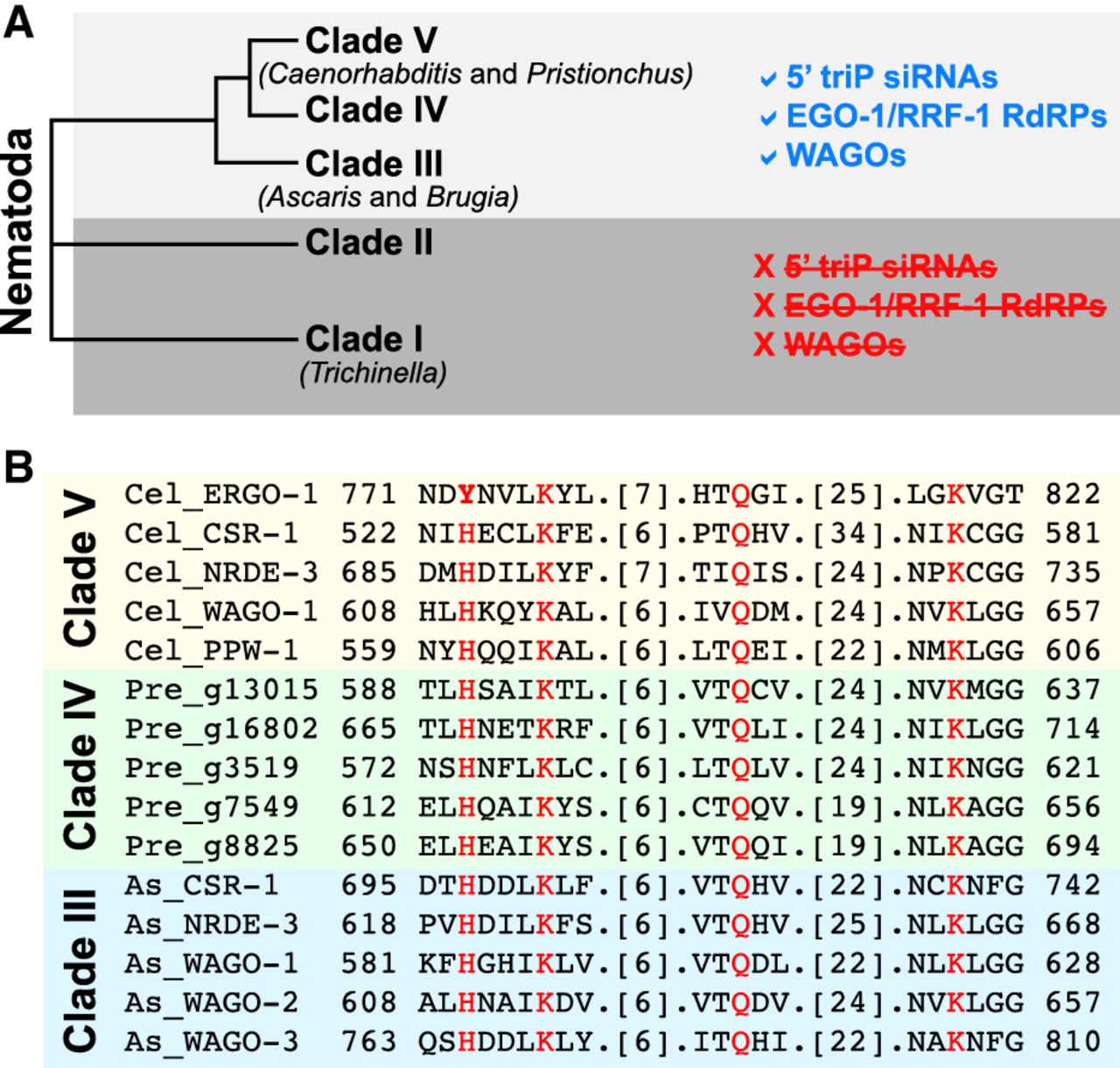
FIGURE 4.
Conservation of the HKQK motif across Nematoda WAGO Argonautes. (A) Cladogram of the Nematoda phylum, with representative genera indicated. 5′ Triphosphorylated RNAs, EGO-1/RRF-1 RdRPs, and WAGO Argonautes are present in clades III-V but absent from clades I and II. (B) Protein sequence alignment of WAGO Argonautes from clade III (Ascaris suum), clade IV (Panagrellus redivivus), and clade V (C. elegans) shows conservation of the divergent HKQK motif in the MID domain. C. elegans ERGO-1, a primary AGO-clade Argonaute, is included for comparison and retains the canonical YKQK motif (Buck and Blaxter 2013; Zagoskin et al. 2022). Sequence alignment was generated using T-coffee (Notredame et al. 2000).




