


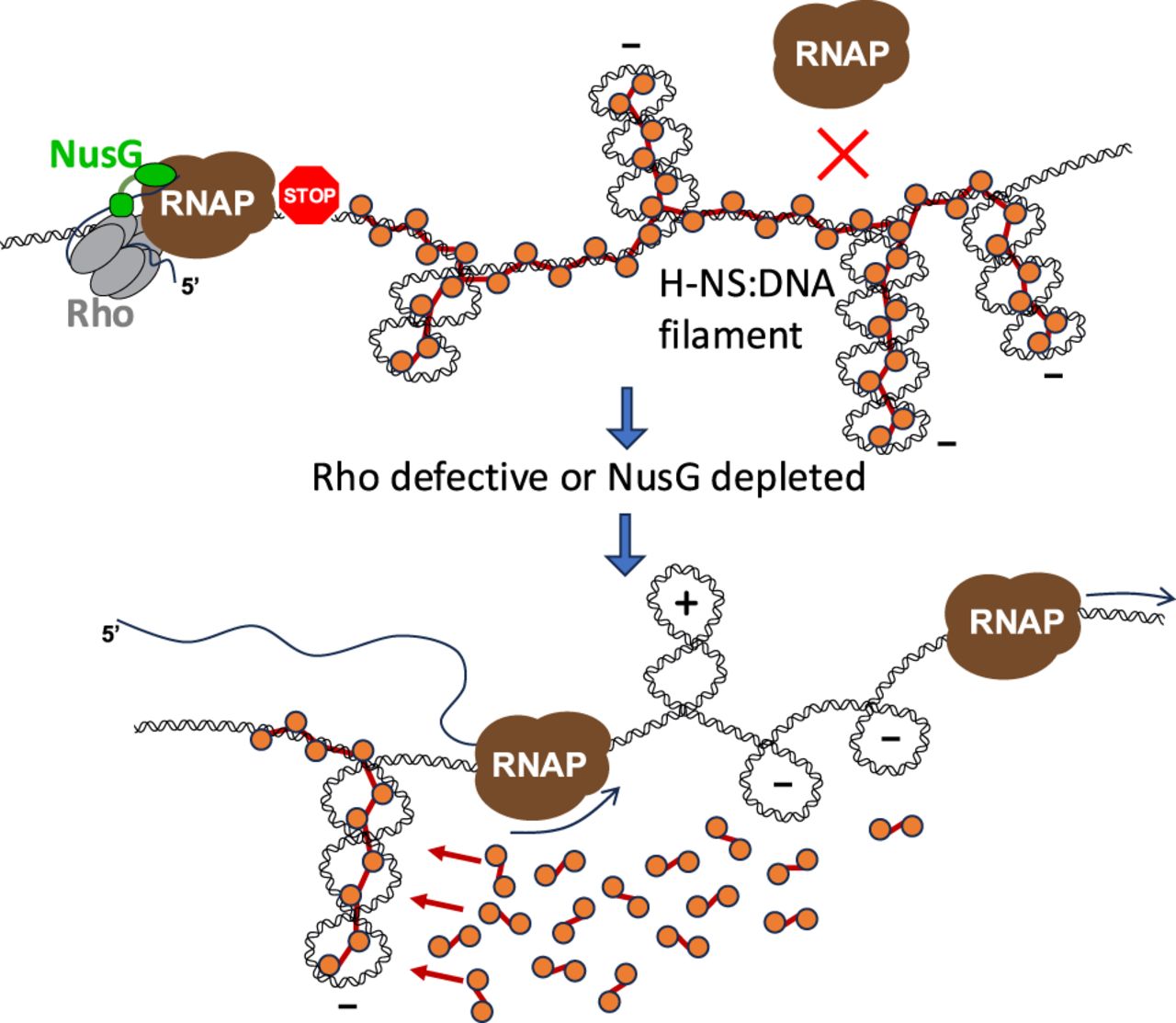
Model for the role of RDTT in H-NS-mediated gene silencing. H-NS:DNA filaments form on negatively supercoiled DNA and constrain negative supercoils (Tupper et al. 1994). H-NS represses transcription initiation from multiple promoters within the filament, including spurious intragenic promoters. Transcripts from promoters that escape repression are intercepted and terminated by Rho, aided by NusG (top). This function is crucial for maintaining the silenced state. If Rho or NusG is defective, RNAP invades the H-NS:DNA filament, generating positive DNA supercoiling as it translocates along the DNA (Wu et al. 1988). As positive and negative supercoils neutralize each other, the resulting loss of negative superhelicity destabilizes the H-NS:DNA complex, leading to transient filament disassembly (bottom). The filament rapidly reassembles after RNAP passage, driven by the surge of negative supercoils accumulating behind the elongating RNAP.




