


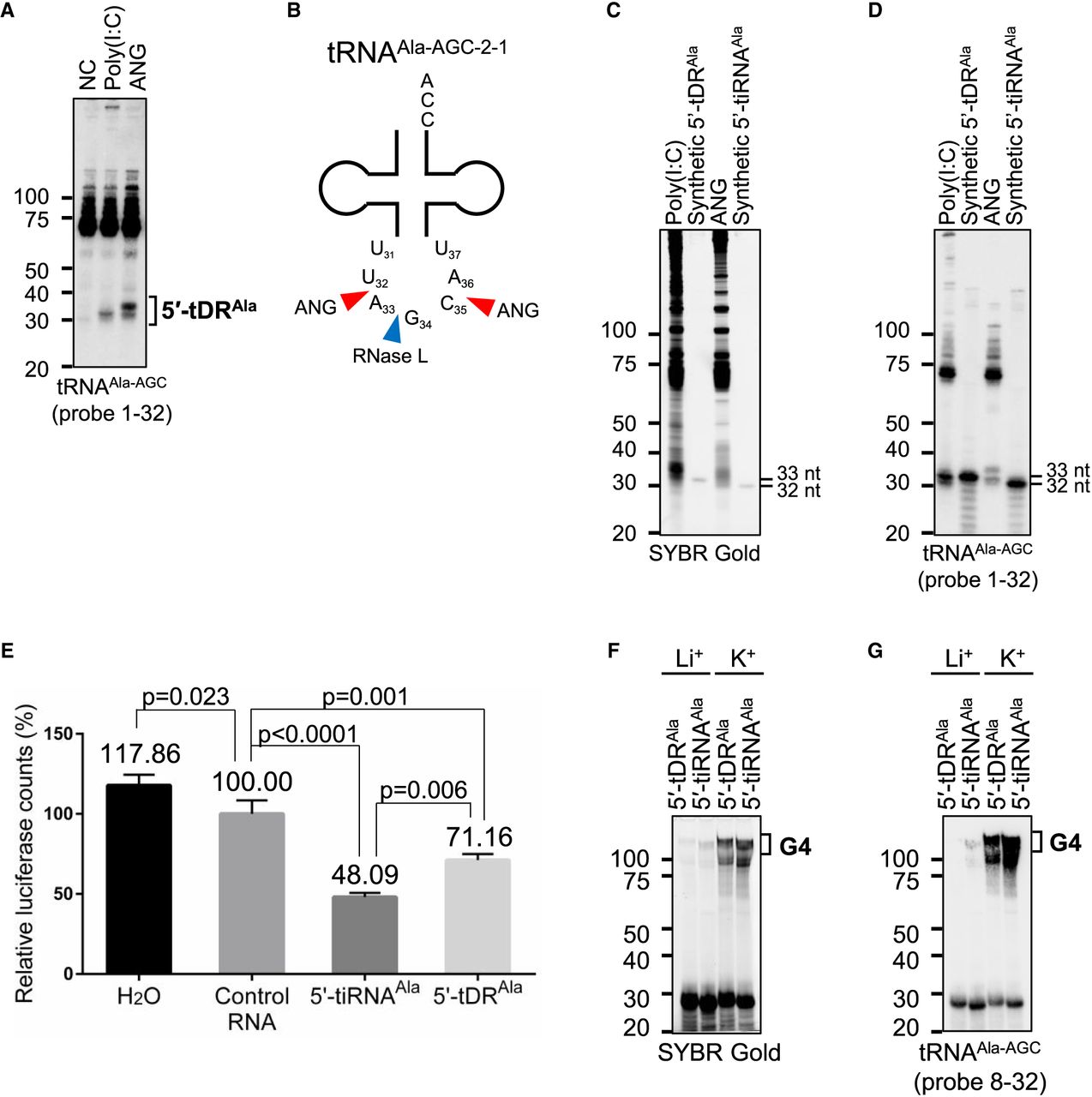
RNase L-induced 5′-tDRAla shows a translation inhibitory effect. (A–D) Comparison between RNase L-induced 5′-tDRAla and ANG-induced 5′-tiRNAAla. (A) Northern blotting for tRNAAla-AGC. (B) Predicted cleavage sites of tRNAAla-AGC-2-1 by ANG/RNase L. Red and blue arrowheads indicate the predicted sites of ANG-mediated and RNase L-mediated cleavage, respectively. (C, D) Estimation of the length of RNase L-induced 5′-tDRAla and ANG-induced 5′-tiRNAAla. Mobility of the tDRs was compared with that of synthetic 5′-tDRsAla (32 and 33 nt). (C) SYBR Gold staining and (D) northern blotting for tRNAAla-AGC. (E) 5′-tDRAla (33 nt) as well as 5′-tiRNAAla (32 nt) inhibit translation of mRNA reporters in vitro. Means and standard deviation were obtained from three independent experiments. Mean values and P-values are shown. (F, G) 5′-tDRAla as well as 5′-tiRNAAla can form G-quadruplex structure. (F) SYBR Gold staining and (G) northern blotting for tRNAAla-AGC.




