


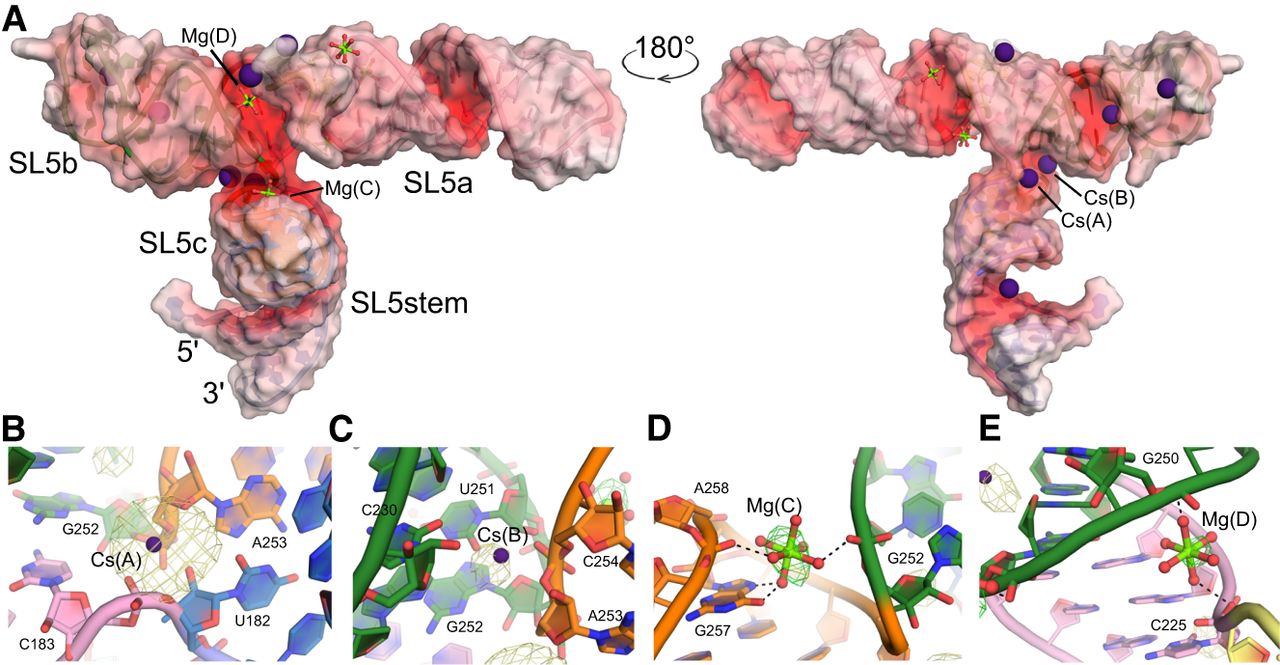
Counterions localize to negatively charged pockets of the stem–loop 5 (SL5) four-way junction. (A) Electrostatic potential (red to white, −15 kBT/e− to 0 kBT/e−) for SL5 (Cs+ derivative) mapped onto its molecular surface. Two Cs+ ions and two hydrated Mg2+ ions are resolved in the structure. (B) Cs(A) site at the junction of the four helical elements. (C) Cs(B) site between SL5b and SL5c. (D) Mg(C) site between SL5b and the GAAA tetraloop of SL5c. (E) Mg(D) site between SL5a and SL5b. For (B)–(E), crystal structure, colored as in Figure 1, is shown overlaid with the anomalous difference Fourier synthesis (yellow mesh, contoured at 4 σ) or the |Fo|-|Fc| residual map (green mesh, contoured at 4 σ) prior to building non-Cs+ ions and waters. Putative hydrogen bonds between magnesium ion hydrate and the RNA are indicated by black dashes.




