


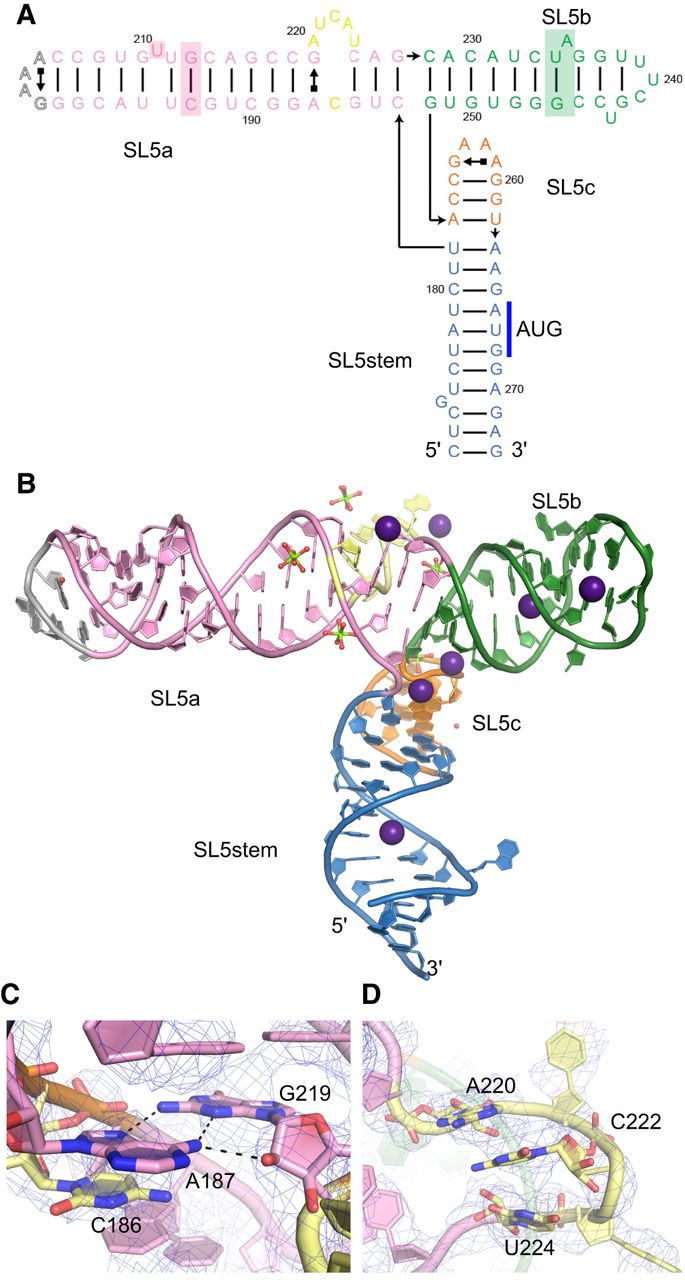
Structure of the SARS-CoV-2 stem–loop 5 (SL5) determined by X-ray crystallography. (A) Secondary structure of SL5, colored as stem SL5a (pink), SL5a bulge (yellow), stem SL5b (green), stem SL5c (orange), and SL5 stem (blue). Residues altered to facilitate crystallization are gray. Two notable base triples in SL5a and SL5b are boxed. Leontis–Westhof symbols (Leontis and Westhof 2001) denote base pairs. Arrows indicate chain connectivity. Blue bar denotes AUG start codon for ORF1 at nts 266–268. SARS-CoV-2 reference genome (NC_045512.2) numbering is used throughout. (B) Cartoon representation of the crystal structure (Cs+ derivative), colored as in A. Pink, purple, and lime spheres denote waters, Cs+ ions, and hydrated Mg2+ ions, respectively. (C) View of A187·G219 sheared pair above C186 and overlaid with the experimental (single-wavelength anomalous dispersion [SAD]) electron density map (blue mesh) for Data set 1, contoured at 2 σ. Putative hydrogen bonds are indicated by black dashes. (D) Stacking of SL5a bulge residues A220, C222, and U224 overlaid with the experimental electron density map (blue mesh) for Data set 1 contoured at 1.5 σ. For (C) and (D), ions were removed for clarity.




