


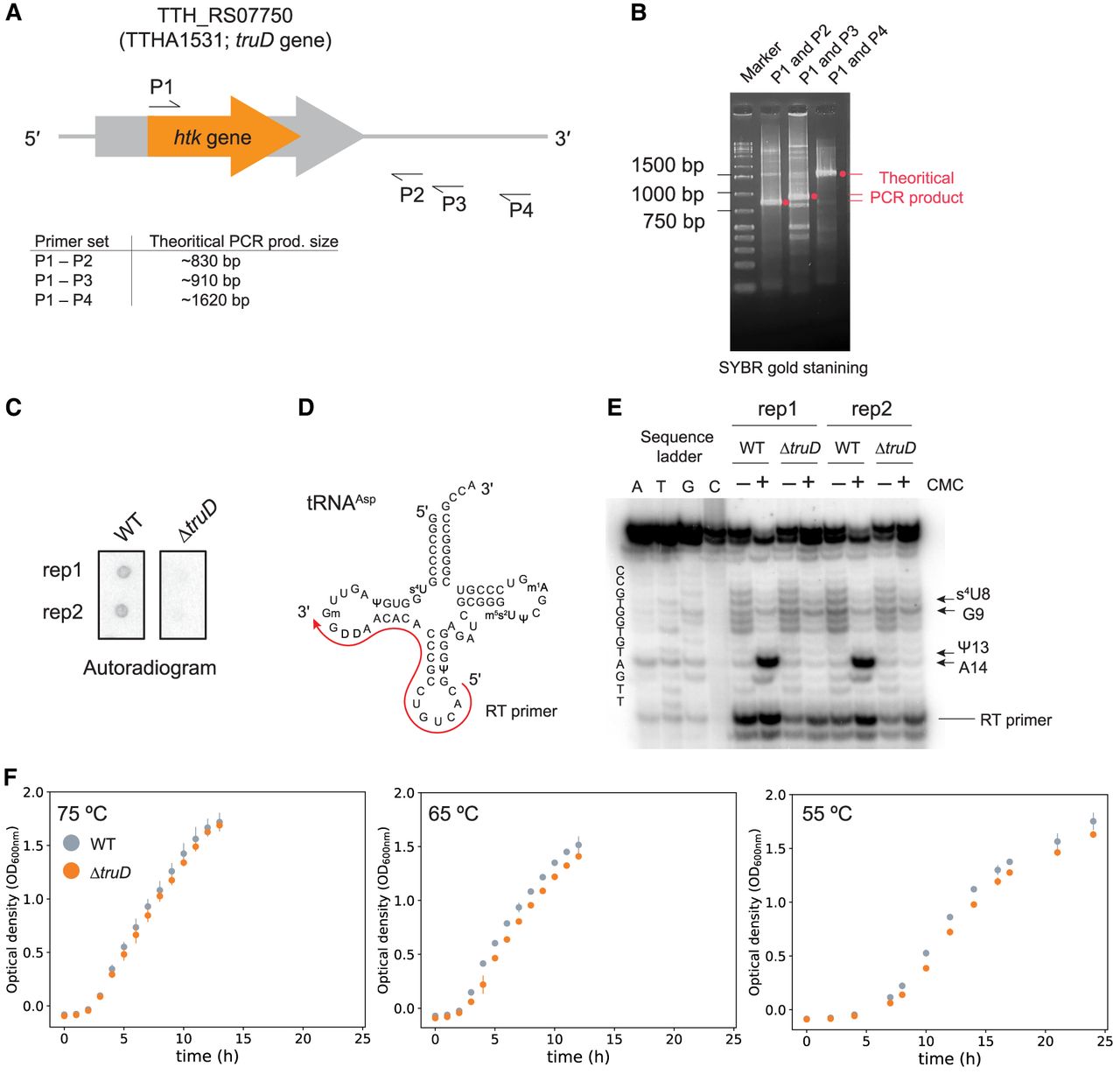
Disruption of the truD gene does not affect growth. (A) The highly thermostable kanamycin-resistance gene htk (orange arrow) was inserted into the truD locus (TTH_RS07750, also known as TTHA1531, gray) by homologous recombination. The gene disruption was tested by PCR with three different primer sets (P1–P2, P1–P3, and P1–P4). The theoretical sizes of each PCR product are provided. (B) The PCR products were analyzed by 2% agarose gel electrophoresis and visualized with SYBR Gold. The circles highlighted in red indicate the theoretical PCR product. (C) The disruption of truD gene in T. thermophilus genome was tested by dot-hybridization, where 32P-labeled truD gene-specific primer was used for a detection probe. (D) Secondary structure of tRNAAsp is shown. The red arrow shows the RT primer-annealing region. (E) tRNA mixture was treated with CMC to probe pseudouridine modifications. The resulting RNAs were used in primer extension reactions. The RT product was analyzed using 15% denaturing PAGE, and RT-terminations were visualized by a phosphor imager. The experiment was independently repeated three times (n = 3). A representative gel image of primer extension experiments is presented. (F) Growth in nutrient-rich medium of WT (gray) and the ΔtruD strain (orange) was monitored at OD600 at 75°C, 65°C, and 55°C. The experiment was independently repeated three times (n = 3). Error bars indicate the standard deviation.




