


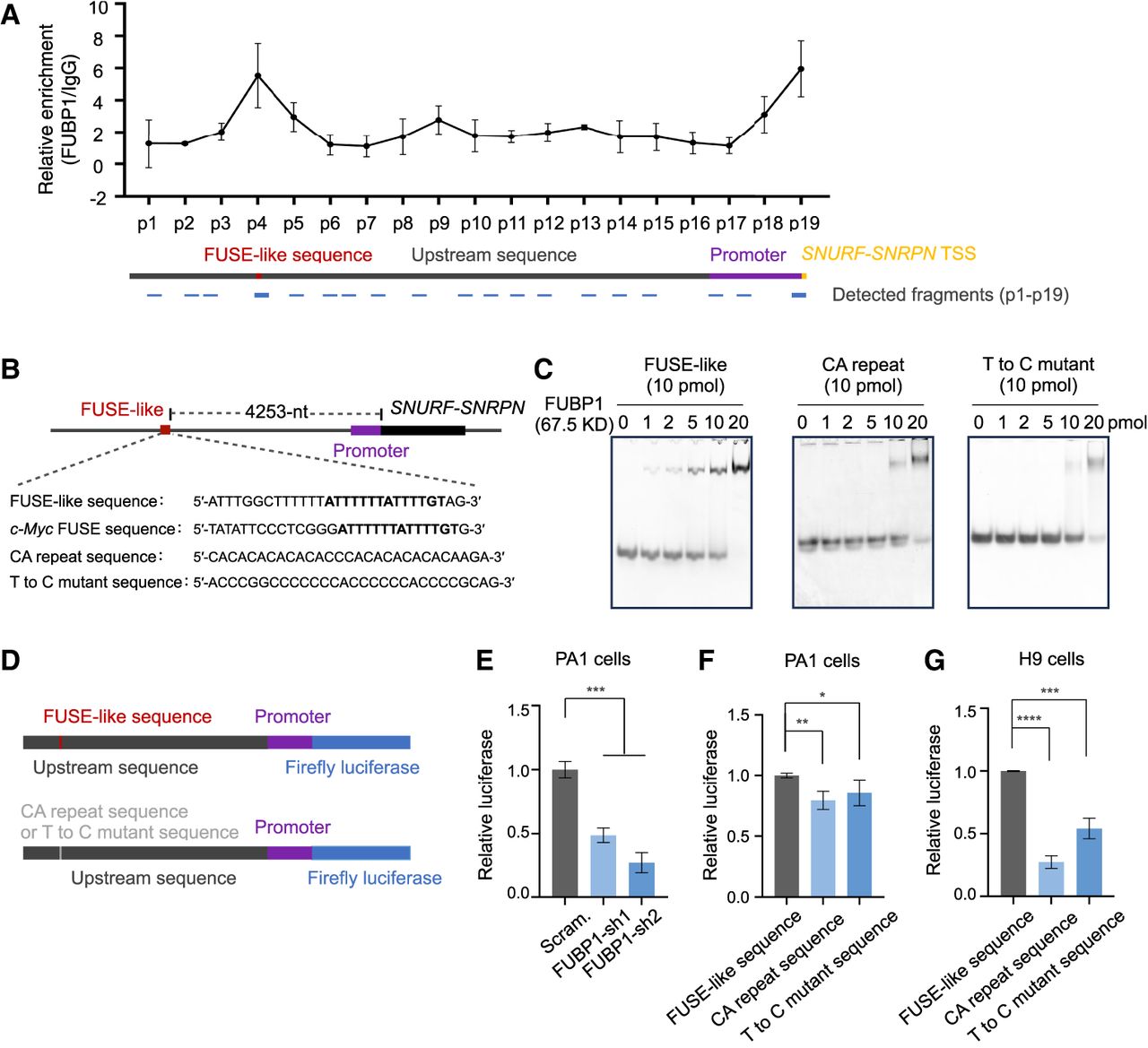
FUBP1 promotes SPAs’ transcription by interacting with a FUSE-like sequence. (A) FUBP1 binds to the DNA fragments that contain the FUSE-like sequence (p4) and the fragments within the promoter sequence (p19) upstream of SNURF-SNRPN TSS, revealed by FUBP1 ChIP-qPCR detection. Locations of the 19 detected fragments are shown at bottom. p4 and p19 fragments are marked in bold. (B) Schematic of the gene organization of SNURF-SNRPN and the upstream FUSE-like sequence. The sequence of FUSE-like sequence, c-Myc FUSE sequence, CA repeat sequence, and T to C mutant sequence are shown below. (C) FUBP1 binds the FUSE-like sequence upstream of the SNURF-SNRPN promoter, revealed by EMSA. (D) Schematic of the luciferase reporter plasmids containing the FUSE-like sequence, CA repeat sequence, or T to C mutant sequence. (E) Knockdown of FUBP1 reduces the transcription of FUSE-like sequence containing reporter plasmids, revealed by the luciferase reporter assay. (F,G) FUSE-like sequence promotes transcription of the reporter plasmids compared to the CA repeat sequence and the T to C mutant sequence in PA1 cells (E) and in H9 cells (F), revealed by the luciferase reporter assay.




