


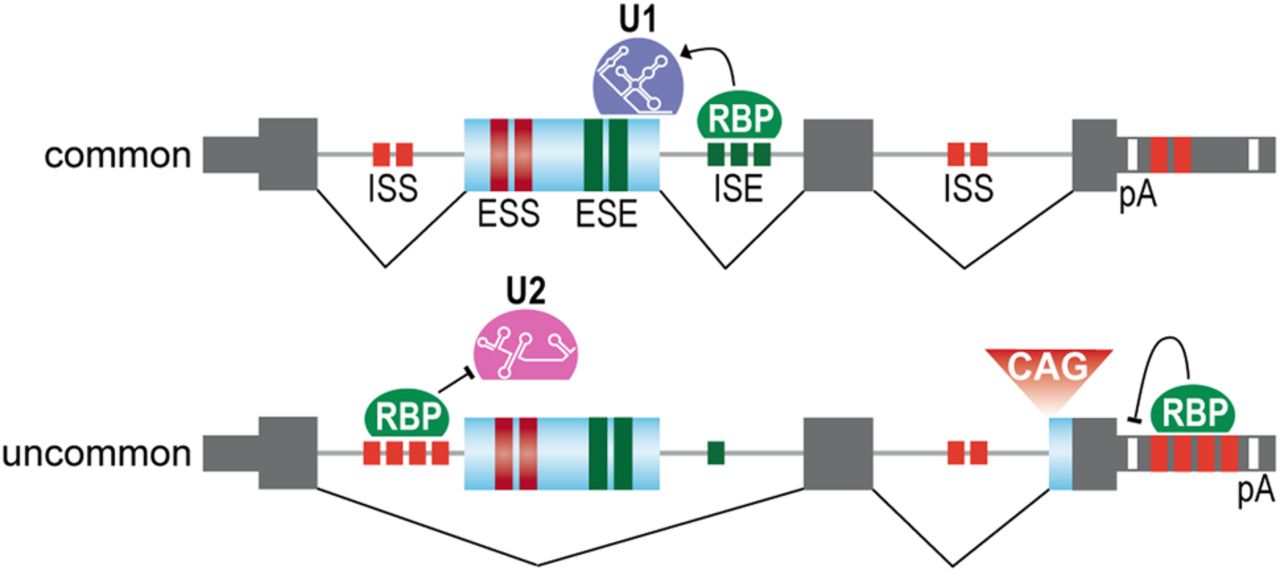
STR functions in pre-mRNA processing. STRs are distributed throughout genic coding and noncoding regions (gray boxes, constitutive exons; blue, alternative exon or 3′ss) and function as copy number dependent alternative processing signals based on RBP recruitment (red boxes, ISS and ESS; green, ISE and ESE). For this example, the top illustration depicts a hypothetical common pre-mRNA processing pattern in the general population. For splicing, exon 2 inclusion is driven by an intron 2 ISE composed of three tandem repeats with coordinate RBP-binding promoting U1 snRNP recruitment. For 3′-end cleavage and polyadenylation, the first polyadenylation site (pA) is selected since there are only two tandem repeats in the downstream region. The uncommon (bottom) splicing pattern shows that exon 2 is skipped due to an intron 2 ISE with only one repeat, while an intron 1 ISS contains four repeats that facilitate RBP recruitment resulting in a U2 snRNP block. This uncommon example also shows an increase in CAG repeats in intron 3 that promotes an alternative exon 4 3′ss together with 3′ UTR repeat number variations that increase RBP recruitment downstream from the proximal pA site leading to selection of the distal site.




