


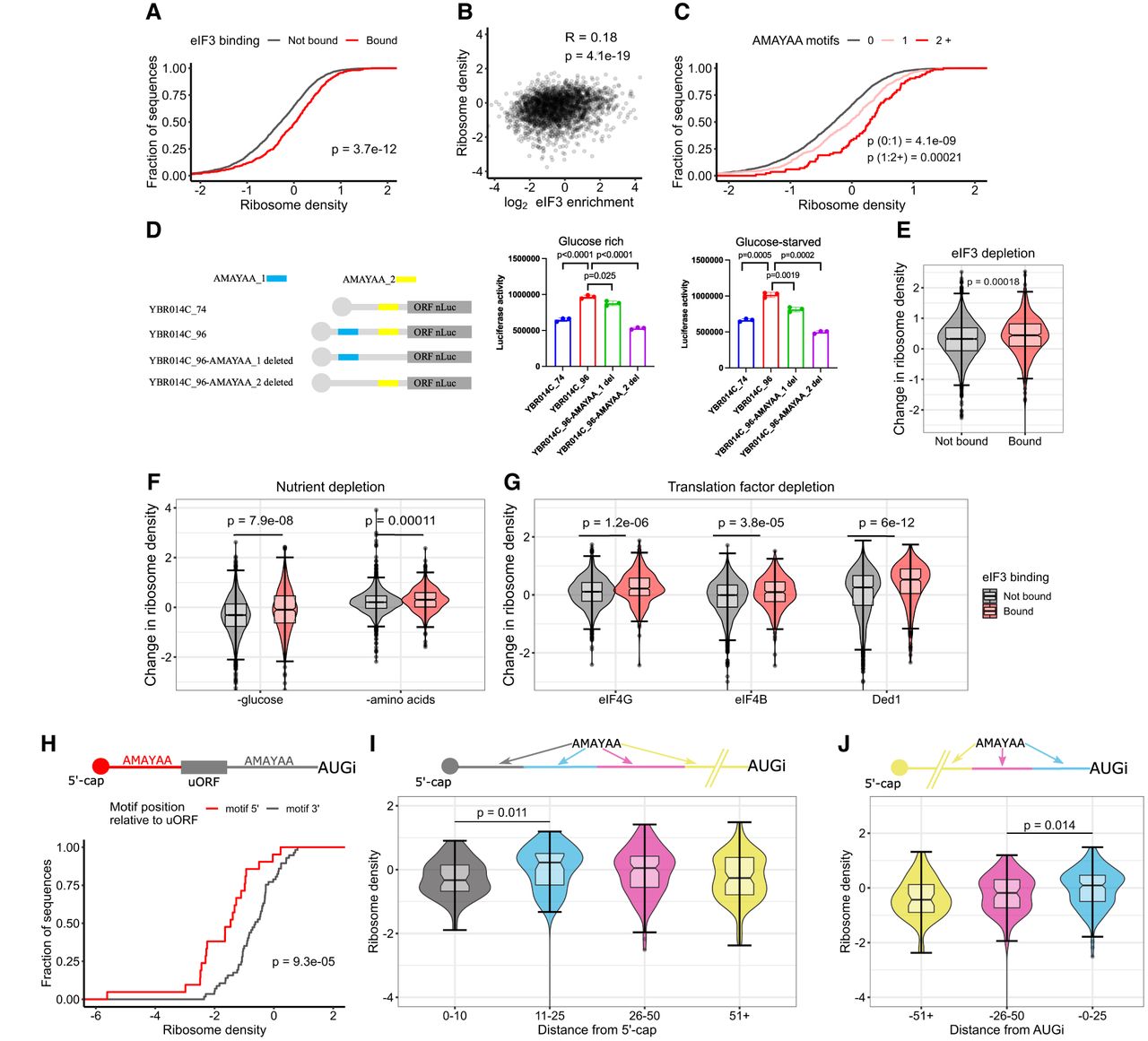
eIF3-binding and AMAYAA motifs enhance ribosome recruitment and start codon recognition in vivo. (A) mRNAs with 5′ UTRs that bound eIF3 in vitro show higher ribosome densities in growing yeast. Cumulative distributions of ribosome densities for bound (red) or not bound (gray) mRNAs. “Bound” includes the union of 55, 166, and 500 nM libraries. Ribosome density equals the average number of ribosome-protected mRNA fragments per mRNA for genes expressing a single dominant 5′-UTR isoform (see Materials and Methods). See Table 2 for ribosome profiling data sources. (B) eIF3 binding in vitro correlates with ribosome density in growing yeast (Pearson). (C) 5′-UTR AMAYAA motifs increase ribosome density in a dose-dependent manner. (D) 5′-UTR AMAYAA motifs promote higher translation of luciferase reporter mRNAs in unstarved conditions (left) and during glucose starvation (right). (E–G) eIF3-binding mRNAs (red) maintain higher ribosome densities than nonbinding (gray) under conditions of limiting eIF3 (E), following acute starvation for glucose or amino acids (F), and upon inactivation of various initiation factors (G). (H) mRNAs with a 5′-UTR AMAYAA motif 5′ to a uORF (red) show reduced ribosome density compared to genes with the motif 3′ (gray). mRNAs were grouped based on the position of the first AMAYAA motif relative to the last uORF. (I,J) Ribosome density varies by AMAYAA motif location for mRNAs without uORFs. Higher ribosome densities for mRNAs with motifs located 11–25 nt from the 5′ end of the mRNA (I) or 0–25 nt upstream of the start codon (J). Bonferroni corrected Mann–Whitney P-values shown for selected comparisons. (A–J) All values of ribosome densities and changes in ribosome densities have been log2-transformed. See also Supplemental Figure S4.




