


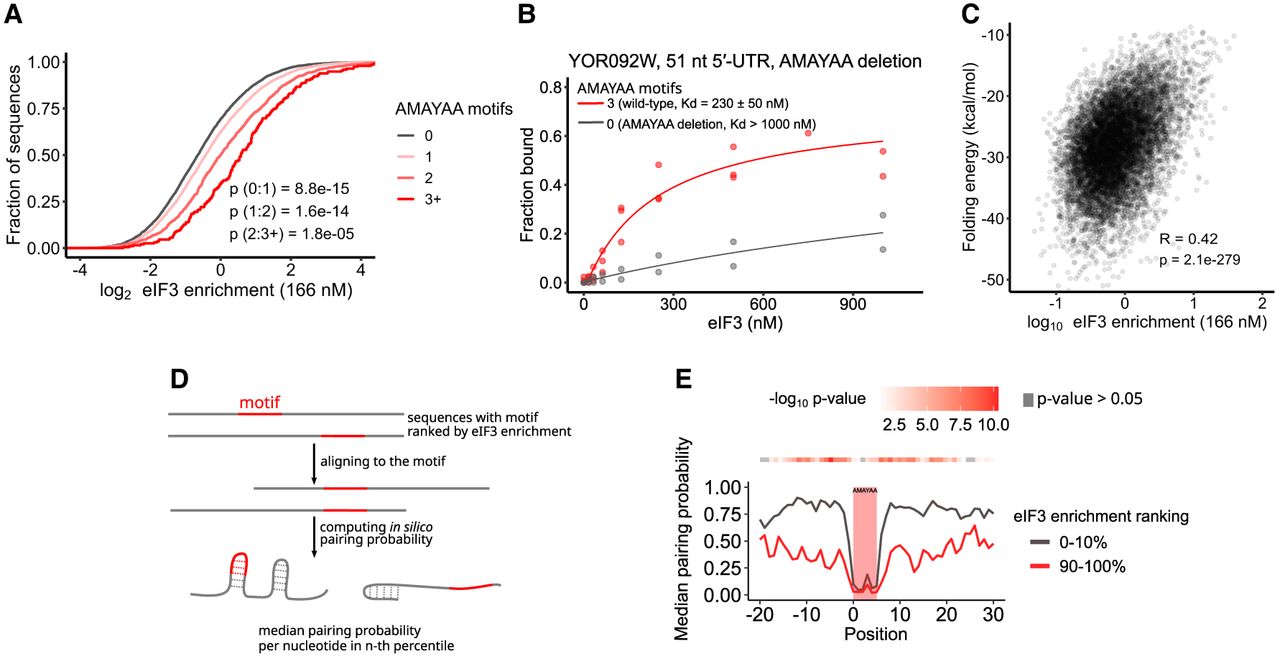
eIF3 recognizes AMAYAA motifs in unstructured regions. (A) eIF3-binding increases with increasing numbers of AMAYAA motifs. Distribution of observed enrichment (166 nM eIF3) for 5′ UTRs with 0, 1, 2, and 3 or more AMAYAA motifs, P-adjusted (Mann–Whitney) for selected pairwise comparisons. (B) eIF3 filter-binding assay of YOR092W_51_SL31s_7 which contains three consecutive AMAYAA motifs (red) and a 10 nt deletion mutant lacking AMAYAA motifs (gray). The best fit of experimental data points (dots) is shown as a line. (C) eIF3 preferentially binds unfolded 5′ UTRs. Enrichment correlates (Pearson) with 5′-UTR folding energies calculated in RNAfold. (D) Overview of RNA motif structure analysis. (E) AMAYAA motifs in tight-binding 5′ UTRs (top decile, red line) are more likely to be presented in unpaired contexts compared to motifs in weak binders (bottom decile, gray line). Median nucleotide pairing probability of 5′ UTRs binned based on their enrichment ranking in the 166 nM library. Position of the motif is indicated by the red rectangle. Benjamini–Hochberg adjusted P-values shown (top) for each nucleotide position. See also Supplemental Figure S3.




