


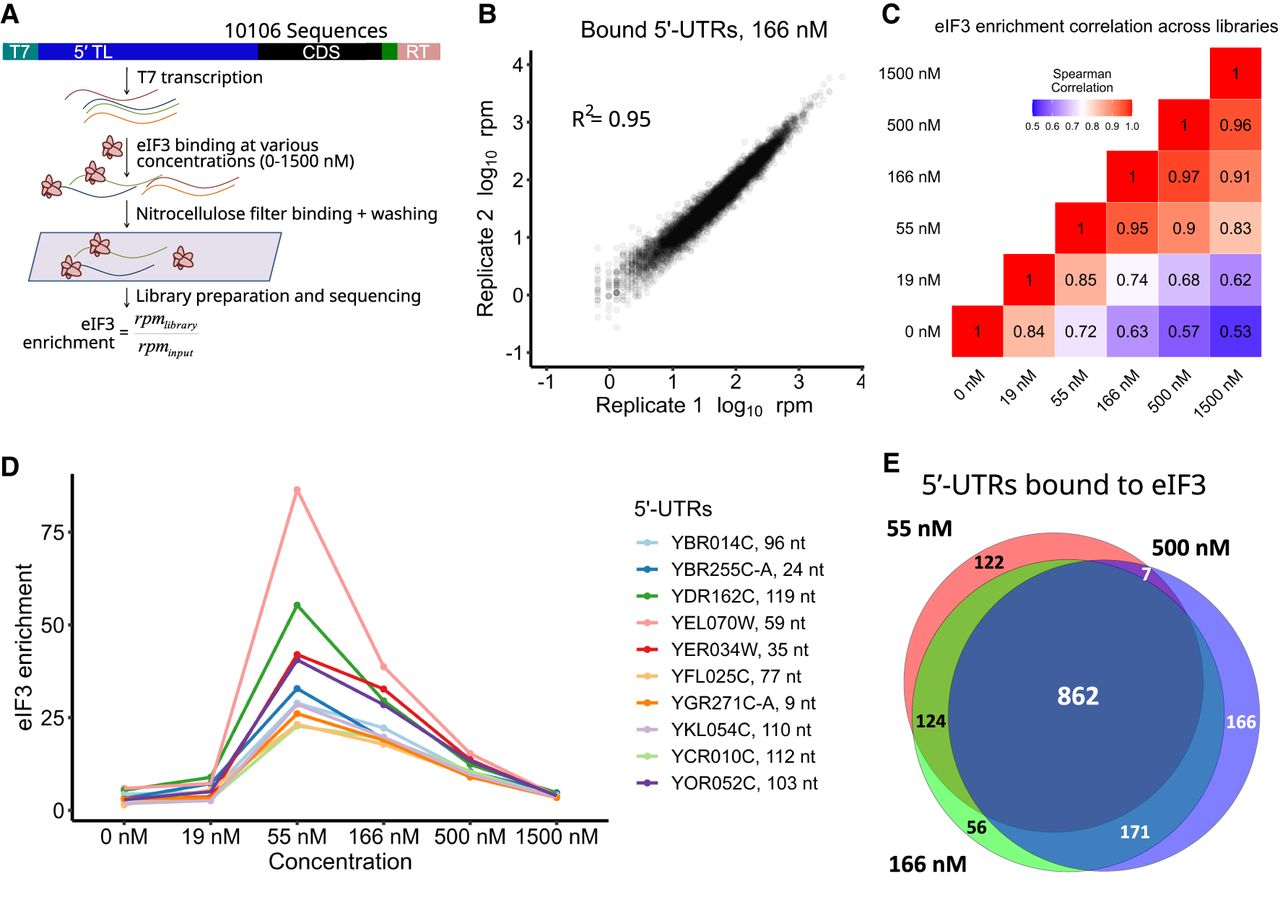
Hundreds of natural yeast 5′-UTRs bind to eIF3 specifically. (A) Scheme of RBNS assay. Designed DNA oligos encoding ∼10,000 yeast 5′-UTRs, plus at least 36 nt of endogenous coding sequence (CDS) are transcribed in vitro. The resulting RNA pool is incubated with various concentrations of purified eIF3, and protein-bound RNAs are captured on nitrocellulose and sequenced. Enrichment is the frequency of a 5′ UTR in the bound sample normalized to input RNA. (B) RBNS results are reproducible. Shown are bound reads in two replicates of 166 nM eIF3. (C) Enrichment between 55 and 500 nM eIF3 was well correlated. (D) Enrichment of the top 10 eIF3 binders from the 166 nM library traced across all libraries. Peak enrichment at 55 nM eIF3 is consistent with high-affinity binding. Less enrichment at higher (eIF3) is expected because low-affinity RNAs consume more of the sequencing lane. (E) Overlap of 5′-UTRs bound in 55, 166, and 500 nM libraries (red, green, and purple, respectively). See also Supplemental Figure S1.




