


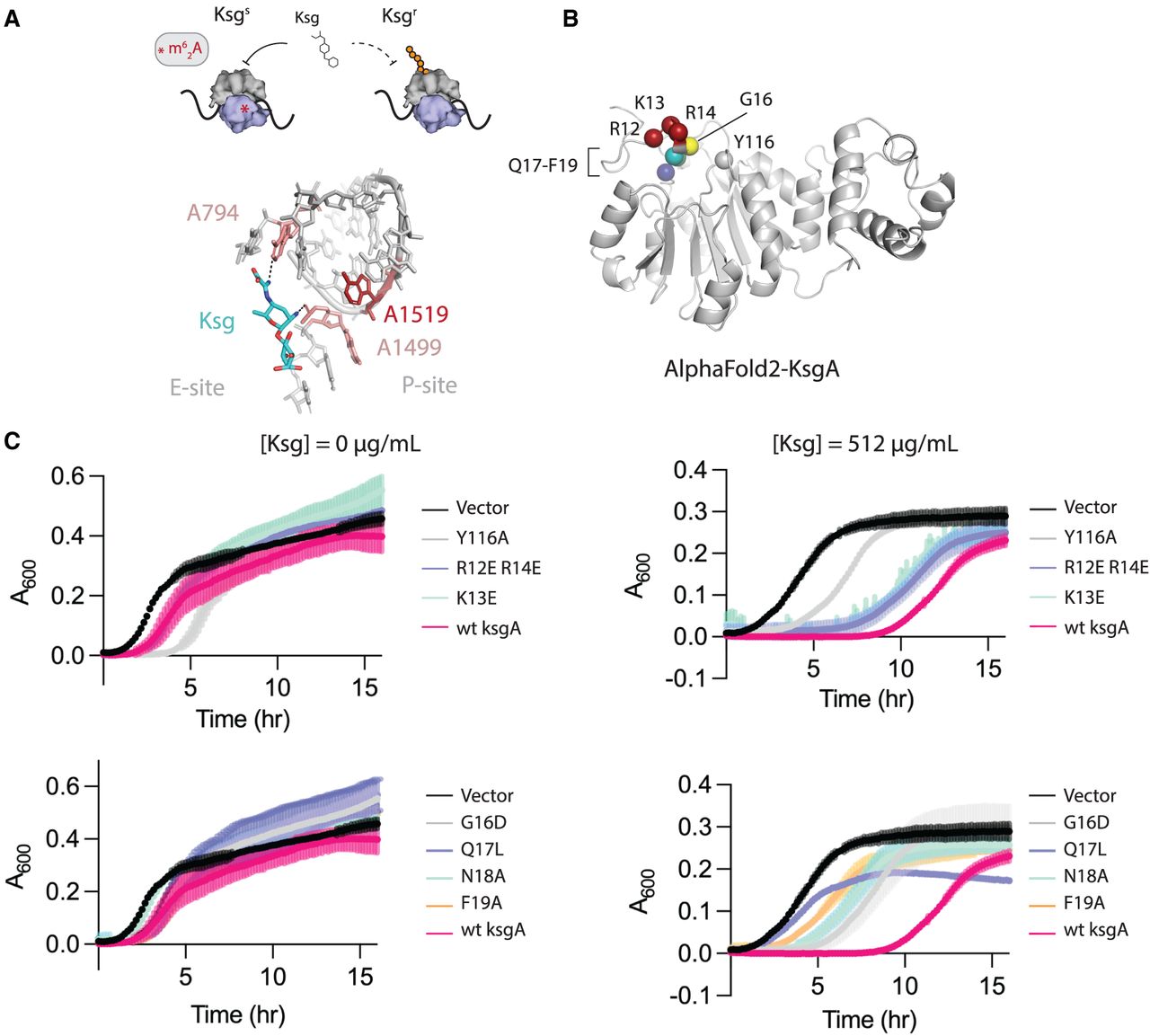
The N-terminal basic patch and motif X of RRAD family member, KsgA, contribute to function in vivo. (A) Kasugamycin (Ksg) inhibits protein synthesis by binding to ribosomes that possess the m62A1519 modification on 16S rRNA. Methylation is indicated by the red asterisk. The structure of Ksg bound to the E. coli ribosome is shown (PDB code 1vs5). A loss of methylation on 16S rRNA residue A1519 affects the local conformation leading to partial Ksg resistance. (B) An AlphaFold2 model of E. coli KsgA shows the predicted location of the basic region R12-R14 and motif X residues G16-F19. (C) Growth curves of E. coli ΔksgA in the absence or presence of kasugamycin. The cells are transformed with wild-type wt ksgA, a site-directed mutant of ksgA or empty vector (Vector). Y116A is included as a control because it is defective in methylation. Three independent cultures were monitored for each variant, and the mean and standard deviation of each time point is plotted.




