


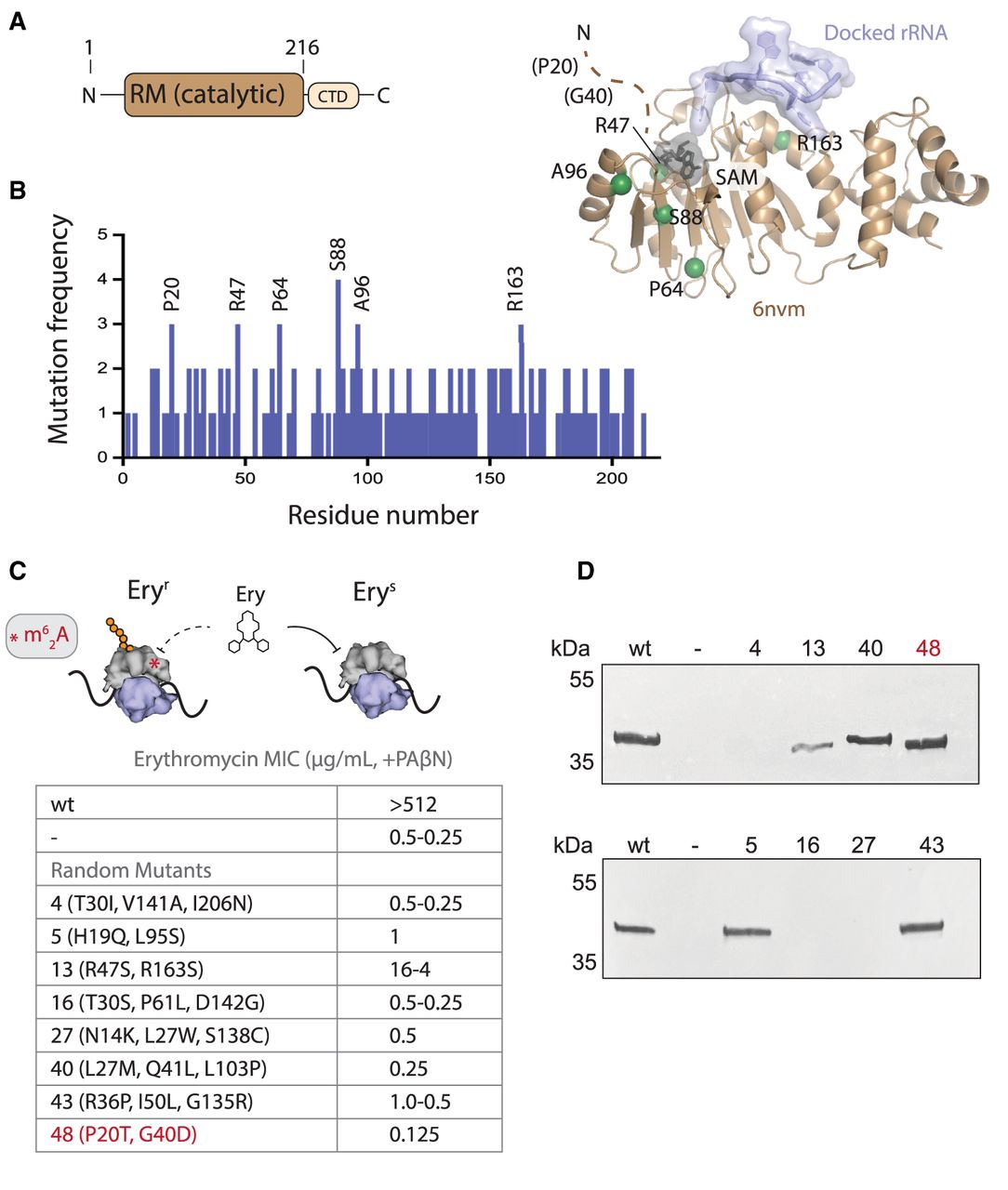
Random mutagenesis reveals that mutations in the dynamic, N-terminal region of ErmE are associated with an erythromycin-sensitive phenotype. (A) The crystal structure of the RRAD family member ErmE lacks the dynamic, N-terminal region. Docking of SAM onto the crystal structure and rRNA via Rosetta modeling gives the approximate positions of the substrates. The residues most frequently associated with an erythromycin-sensitive phenotype in random mutagenesis screens are shown as spheres. Residues P20 and G40 were not present in the coordinate model. (B) Random mutagenesis of the catalytic, Rossmann-like methyltransferase (RM) domain of ermE was performed. A histogram shows how often specific ermE residues were mutated among clones that were erythromycin sensitive. (C) Minimal inhibitory concentrations (MIC) for erythromycin were measured in E. coli cells expressing ermE mutants in the presence of the antibiotic adjuvant phenyl-arginyl-β-napthylamide (PAβΝ). Random mutagenesis produced variants with two to four mutations per clone. MIC values were measured from three replicates. The range of MIC values observed is reported. Where one value is listed, all replicates possessed this value. (D) Western blotting of cell lysates was used to detect whether ermE mutants produced a soluble and stable protein. Mutant 48 is highlighted in red to denote it is the sole mutant composed of only N-terminal changes.




