


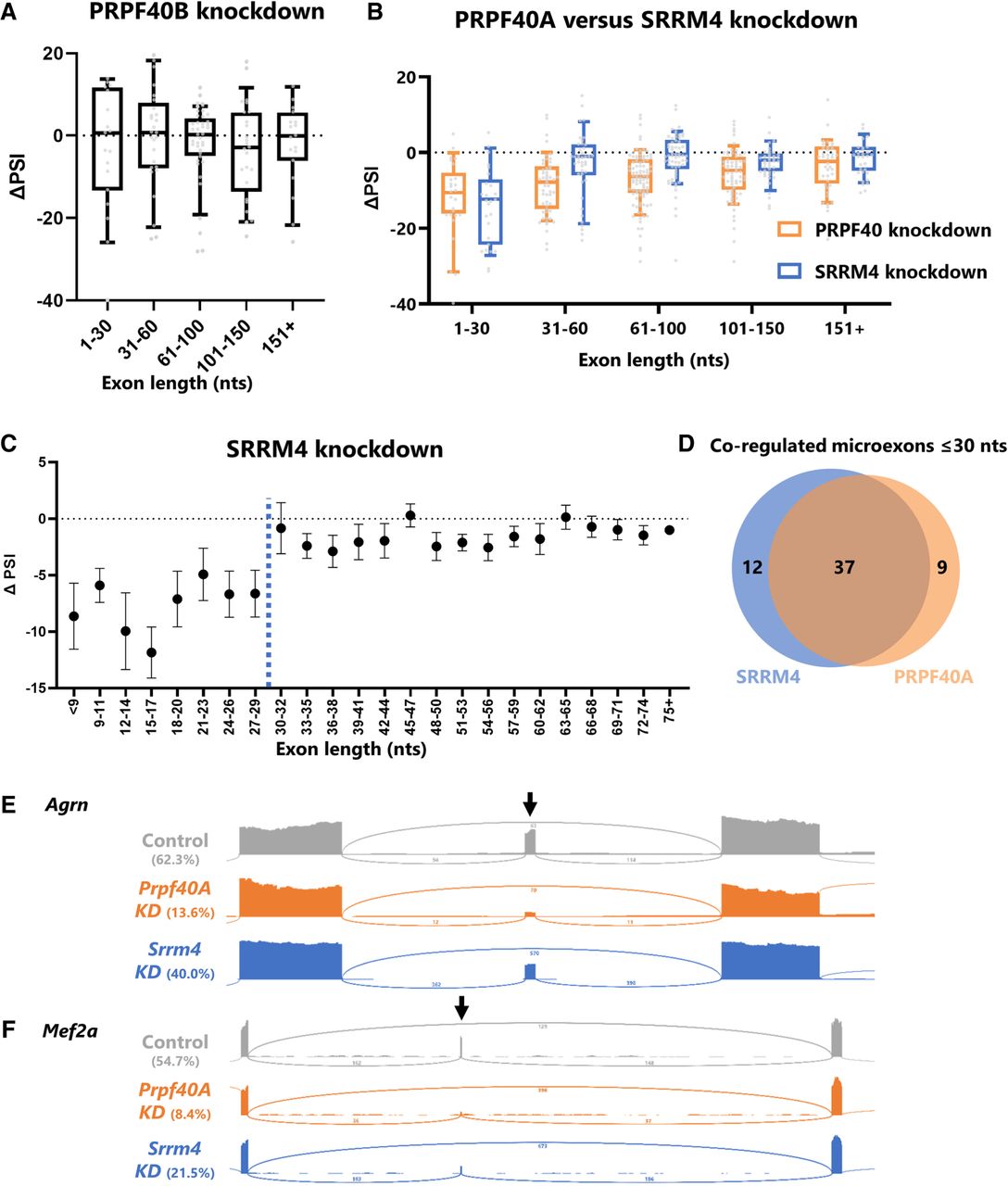
SRRM4 and PRPF40A coregulate microexons. (A) In contrast with PRPF40A knockdown, PRPF40B knockdown does not result in global splicing defects with respect to exon length. (B) SRRM4 knockdown results in loss of microexon inclusion. Both PRPF40A and SRRM4 are required for microexon splicing, but only PRPF40A is required for other small exon splicing (e.g., the 31–60 nt bin). (C) Finer-grained binning of SRRM4-dependent exons reveals a threshold of 30 nt beyond which SRRM4 is not globally required for exon inclusion. Note that these ΔPSIs are averages, and thus some exons of larger size are inevitably regulated by Srrm4. (D) Venn diagram showing microexons that were detected in both the Srrm4 and Prpf40A knockdowns (minimum 15 junctions in all six replicates plus all three control replicates), coregulated as defined by |ΔPSI}>5% in both conditions. (E) Example of a microexon (in Agrn) strongly dependent on PRPF40A but only mildly regulated by SRRM4. (F) Example of a microexon (in Mef2a) coregulated by SRRM4 and PRPF40A.




