


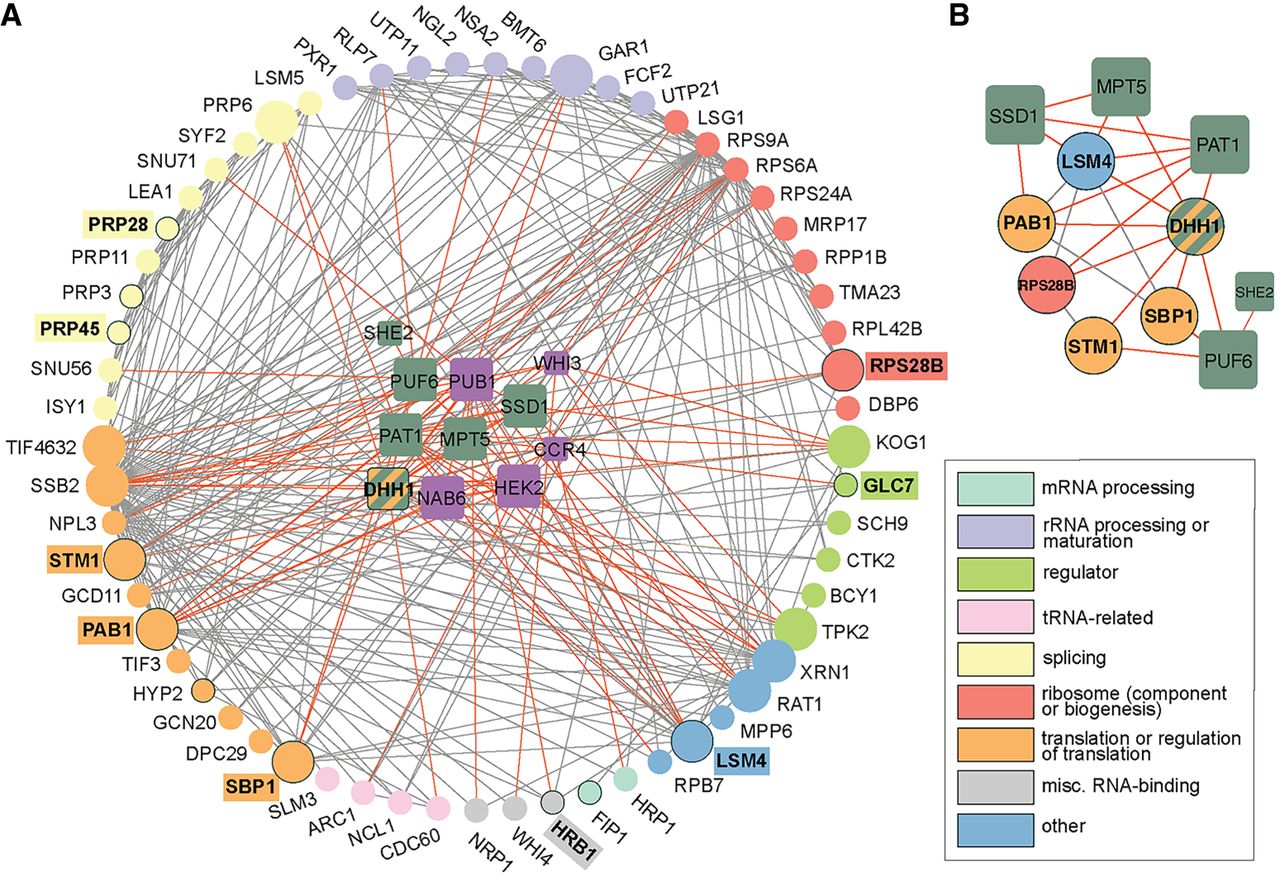
RBPs that genetically interact with aneuploidy physically interact with duplicated proteins that complement aneuploid ssd1Δ defects. (A) Sixty-five peripheral nodes (circles) represent genes related to translation and RNA biology (colored with simplified annotations according to the legend) whose duplication is especially beneficial to Chr12 ssd1Δ aneuploids. Central nodes (squares) represent significant RBPs from Figure 4, colored purple or green if the deletion alleviates or exacerbates ssd1Δ Chr12 sensitivity. Nodes with a black border (label with colored background) indicate gene duplications that confer a benefit in multiple ssd1Δ aneuploids carrying different chromosome amplifications. Edges represent physical interactions between encoded peripheral proteins (gray) or with an RBP (orange). (B) Complementary network of gene duplicates beneficial to multiple ssd1Δ aneuploids (circles) and RBP deletions (squares) that exacerbate the aneuploid growth defect. DHH1 belongs to both groups.




