


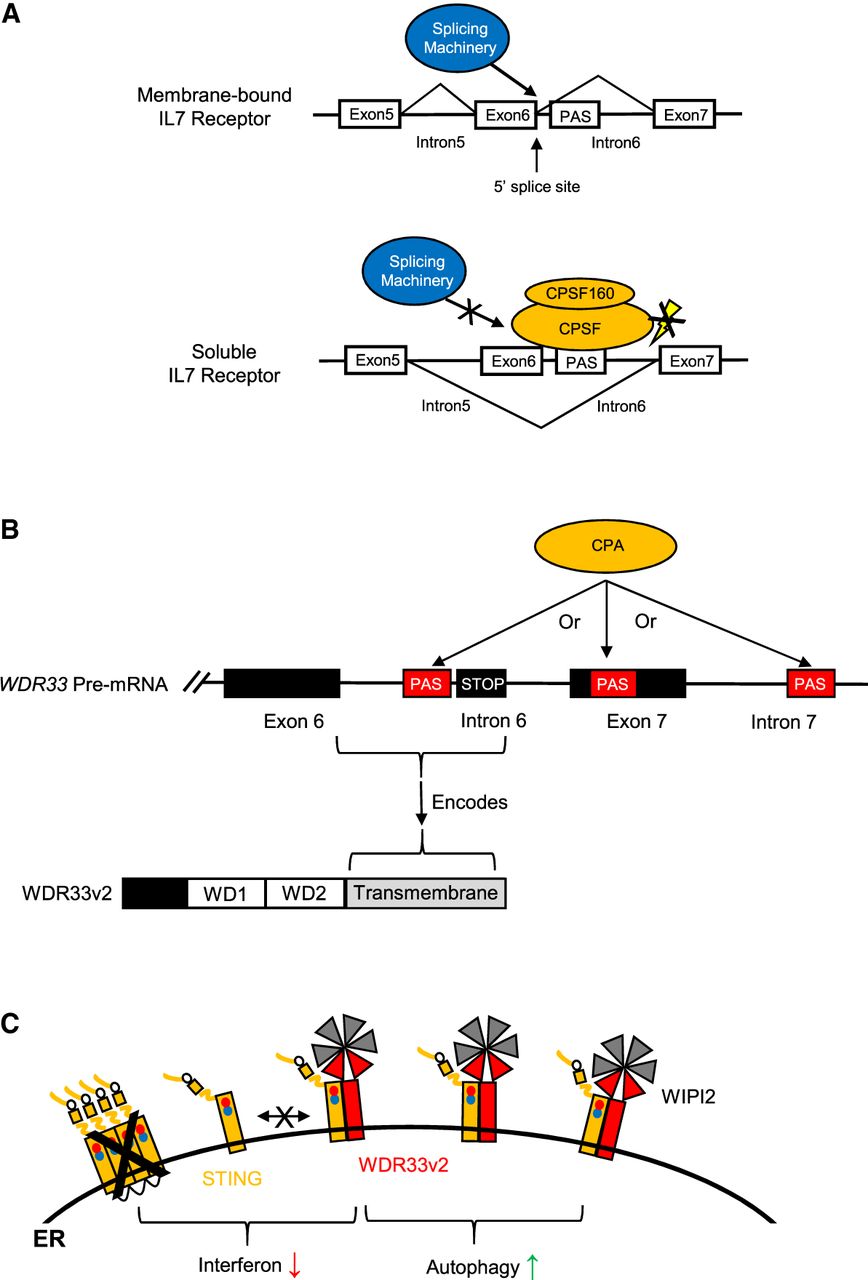
CPSF and WDR33v2 play important roles in innate immunity. (A) Intron 6 of the IL7 receptor pre-mRNA contains a PAS near the 5′ splice site. Removal of intron 6 by the splicing machinery produces the membrane-bound IL7 receptor (top panel). If the PAS is recognized by CPSF, the intron 6 5′ splice site is blocked. Intron 5 5′ splice site is instead used by the splicing machinery together with intron 6 3′ splice site, causing exon 6 to be skipped. This produces the soluble form of the IL7 receptor (bottom panel). CPA do not occur. Lightning bolt: endonucleolytic cleavage. (B) Intron 6 of the human WDR33 pre-mRNA contains an in-frame stop codon, which is associated with multiple functional intronic/exonic PASs (top panel). Usage of either of several of these PASs by the CPA machinery cause intron 6 to be retained, producing the WDR33v2 isoform. WDR33v2 harbors two N-terminal WD repeats and a C-terminal transmembrane domain, which is encoded by the retained intron 6 (bottom panel). (C) WDR33v2 is functionally completely unrelated to the canonical isoform. It localizes to the ER with the intron-encoded transmembrane domain and regulates the immune factor STING. WDR33v2 lowers interferon induction by decreasing STING oligomerization (left), while promoting autophagy activation by recruiting WIPI2 isoforms (right).




