


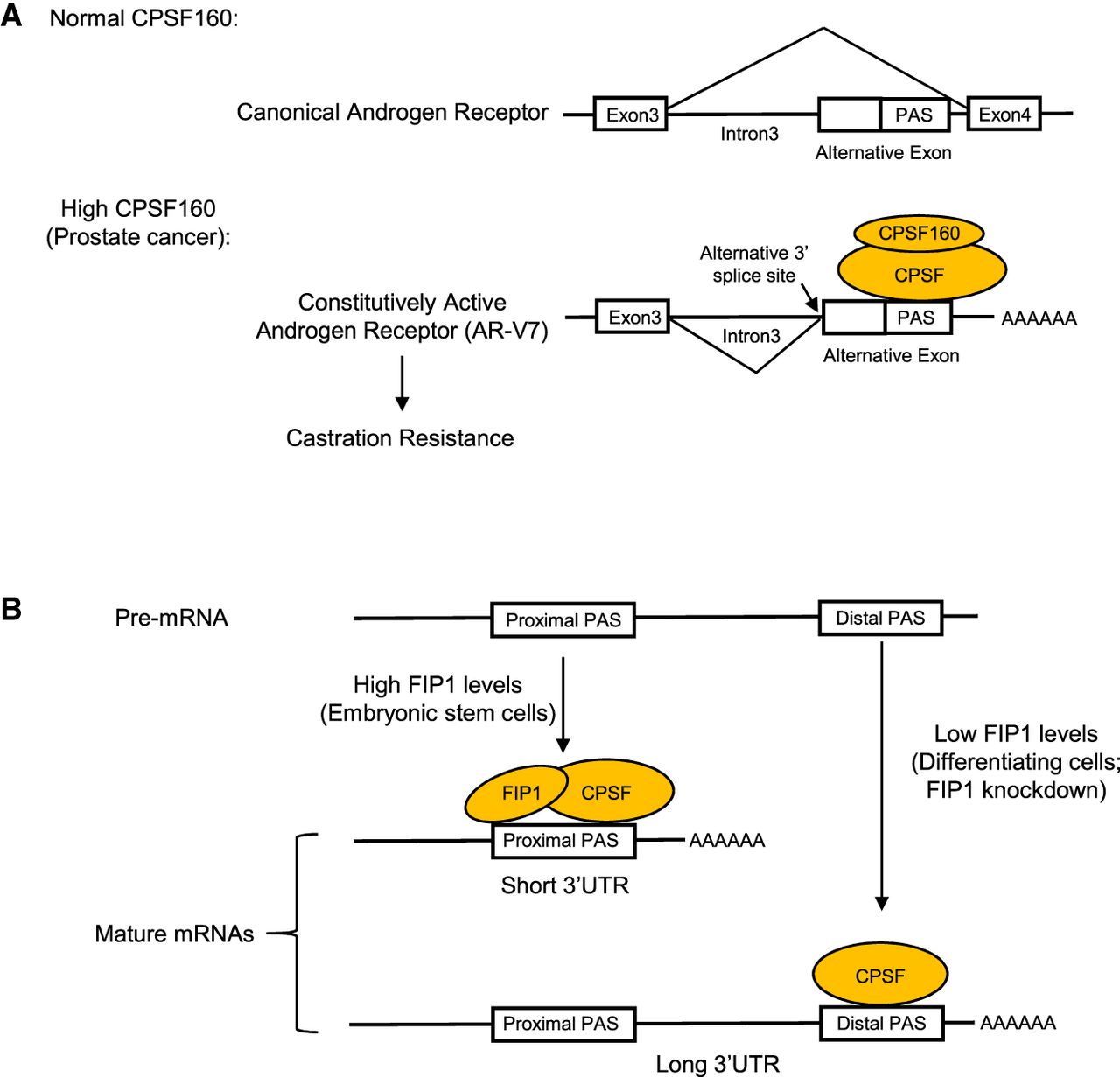
CPSF160 and FIP1 control APA in cancer and differentiation, respectively. (A) Intron 3 of the AR pre-mRNA contains an alternative exon with a cryptic PAS. When CPSF160 is not overexpressed, this intron is removed, producing the canonical transcript (top panel). However, in prostate cancer, CPSF160 is highly expressed. It activates the cryptic PAS, leading to the inclusion of the alterative exon in the mature transcript (bottom panel). This transcript encodes a constitutively active AR isoform termed AR-V7, which confers castration resistance. (B) Many pre-mRNAs contain a proximal and a distal PASs (top panel). In embryonic stem cells, expression levels of FIP1 are high, causing the proximal PAS to be used. Thus, embryonic stem cells tend to have mature mRNAs with short 3′ UTRs (middle panel). In differentiating cells or when FIP1 is knocked down, low FIP1 levels cause CPSF to use the distal PAS, leading to widespread 3′-UTR lengthening (bottom panel).




