


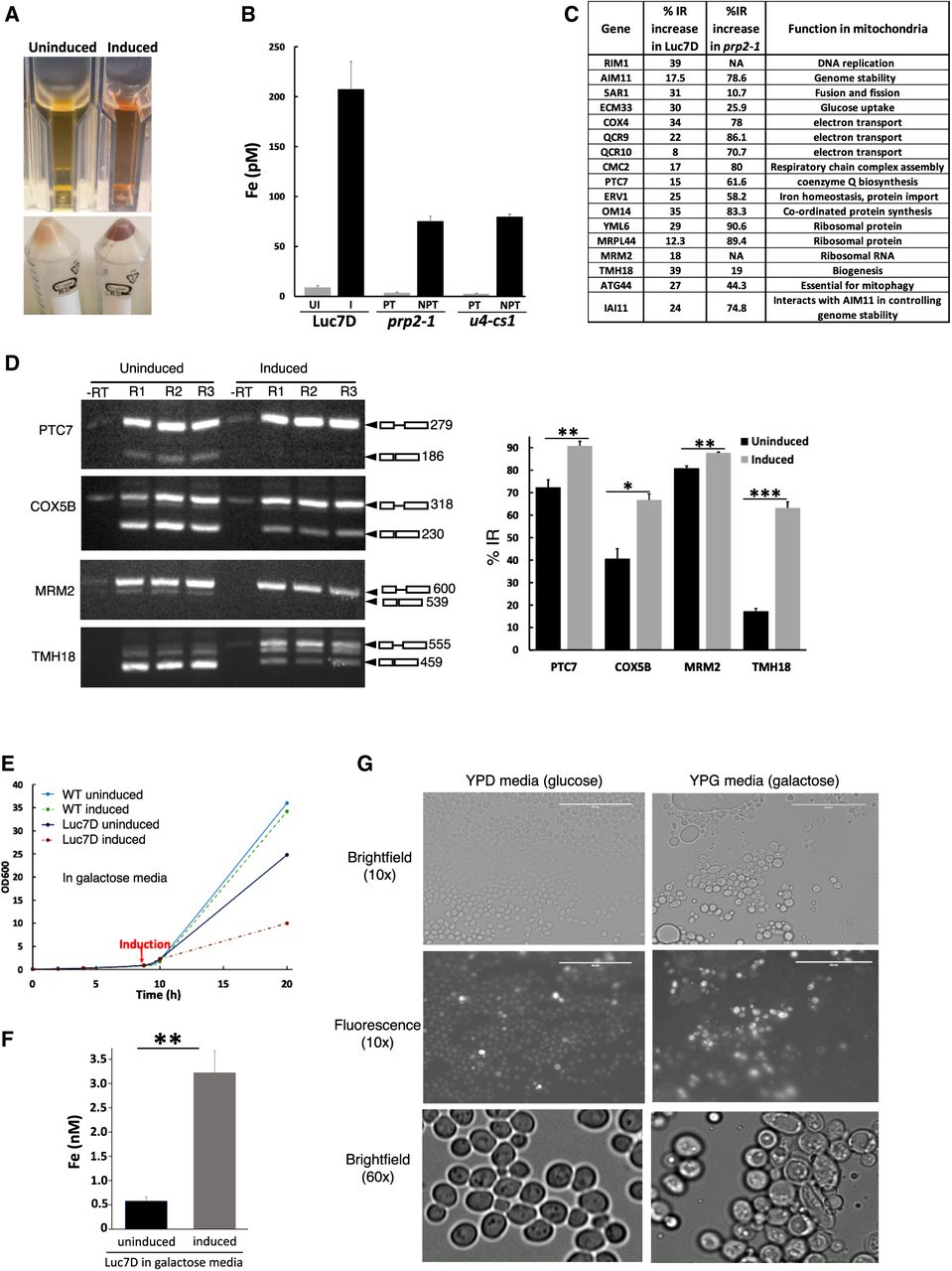
Luc7 depletion leads to mitochondrial dysfunction and galactose toxicity. (A) Luc7 depletion led to Fe2+ release. Both culture supernatants and cell pellets after induction turned rusty red, immediately after the addition of a few drops of 10% commercial bleach. (B) Free iron measurement using ferrozine assay in the Luc7D, prp2-1, and u4-cs1 strains. UI, I, PT, and NPT represent uninduced, induced, permissive temperature, and nonpermissive temperature, respectively. (C) A list of pre-mRNAs with increased IR in RNA-seq analyses of the Luc7D and prp2-1 strain that affected mitochondrial integrity and function. (D) RT-PCR confirmation of RNA-seq results in the Luc7D strain for three genes selected from the list in C and COX5B (which was not in the list of genes affected in the RNA-seq data because of its extremely short exon [1 nt] which cannot be handled by typical sequencing analyses software). (E) Growth curves of auxin and β-estradiol (induced) or ethanol added (uninduced) Luc7D and WT yeast strains in galactose medium (YPG). (F) Significantly more Fe2+ was released into the galactose medium of induced cultures (compared to B) as measured by ferrozine assay. (G) Dihydrorhodamine detection of mitochondrial reactive oxygen species (which manifests as bright fluorescent spots within mitochondria in the fluorescent image) (Laun et al. 2001; Gomez et al. 2014) in the Luc7D strain grown in YPD or YPG upon Luc7 depletion. The intensities of these bright spots were so strong that they were even visible in the bright field image at higher magnification (60×).




