


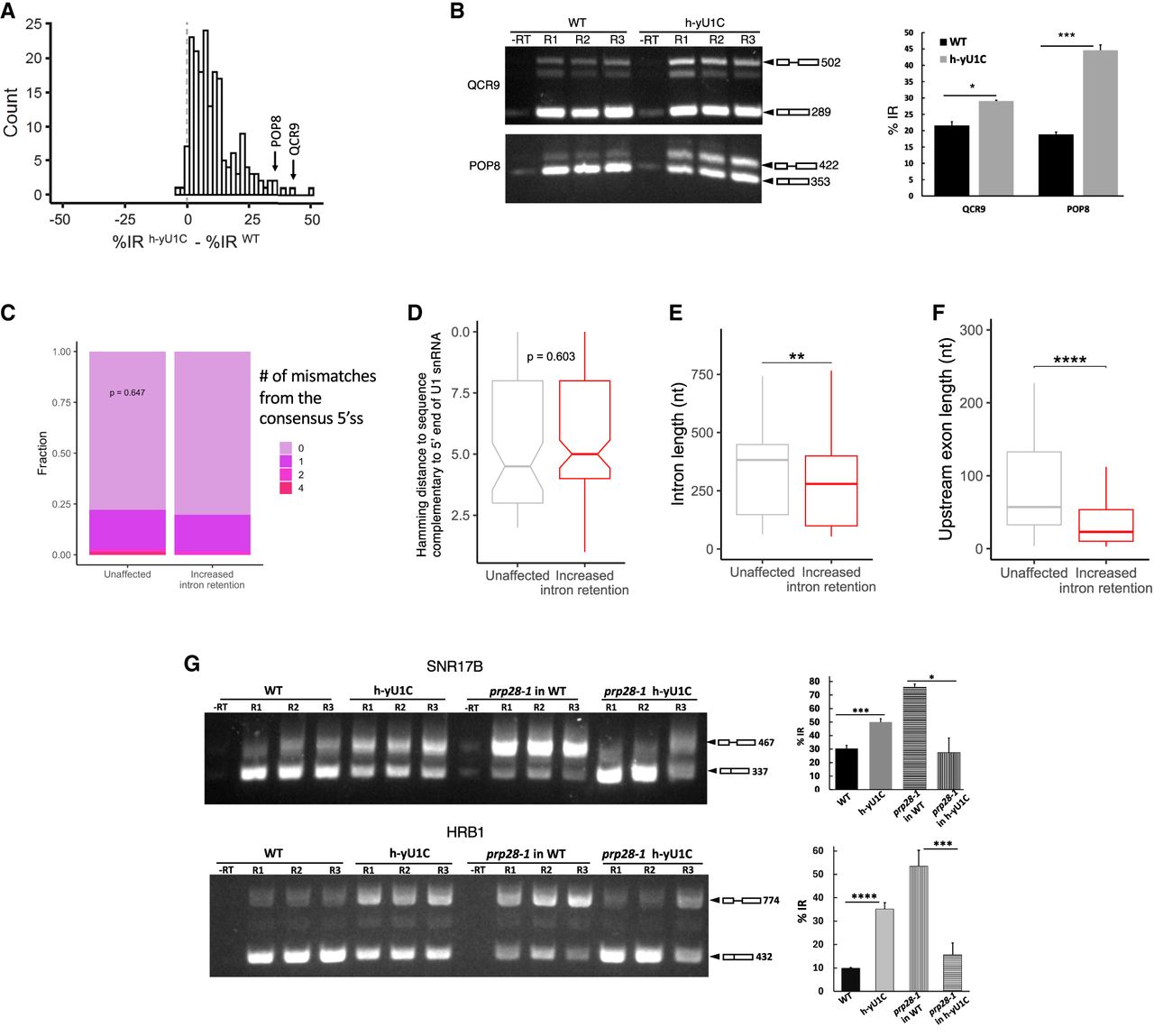
Humanization of yU1C leads to moderate splicing defects. (A) RNA-seq experiments revealed that h-yU1C led to poorer splicing of a moderate number of intron-containing genes as demonstrated by their increased %IR (percentage intron retention). Arrows indicate the two genes selected for RT-PCR validation in B. (B) RT-PCR of POP8 and QCR9 showed that splicing was impaired in the h-yU1C strain at 17°C. POP8 and QCR9 were picked as examples of genes affected by humanizing yU1C in the RNA-seq data as two of the most affected genes. R1–3 represent three biological replicates. (C) There was no significant difference between unaffected and retained introns in how close their 5′ splice sites were to the consensus sequence. P values were calculated using a binomial test considering the fraction of introns with perfect and imperfect matches to the consensus sequence of GTATGT. (D) There was no significant difference between unaffected and retained introns in how close their 5′ splice sites are to the sequence (AGGTAAGTAT) that complements the 10 nt at the 5′ end of U1 snRNA. P values were calculated using a Wilcoxon rank-sum test considering the Hamming distances of introns to the sequence complementary to the 5′ end of U1 snRNA. (E) Increased IR is significantly correlated with shorter intron length. (F) Increased IR significantly correlated with shorter upstream exon. For D, E, and F, introns were identified as having “increased IR” if they had FDR values of <0.05 and an increase in IR value of at least 0.05. Introns that did not meet these criteria were classified as “unaffected.” One hundred and twenty-two introns were classified as having increased IR, and 68 were classified as being unaffected. P values were calculated using a Wilcoxon rank-sum test in D, E, and F. (G) RT-PCR analyses of SNR17B and HRB1 showed that h-yU1C rescued the splicing defect caused by prp28-1. R1–3 represent three biological replicates. (*) P < 0.05, (**) P < 0.01, (****) P < 0.0001.




