


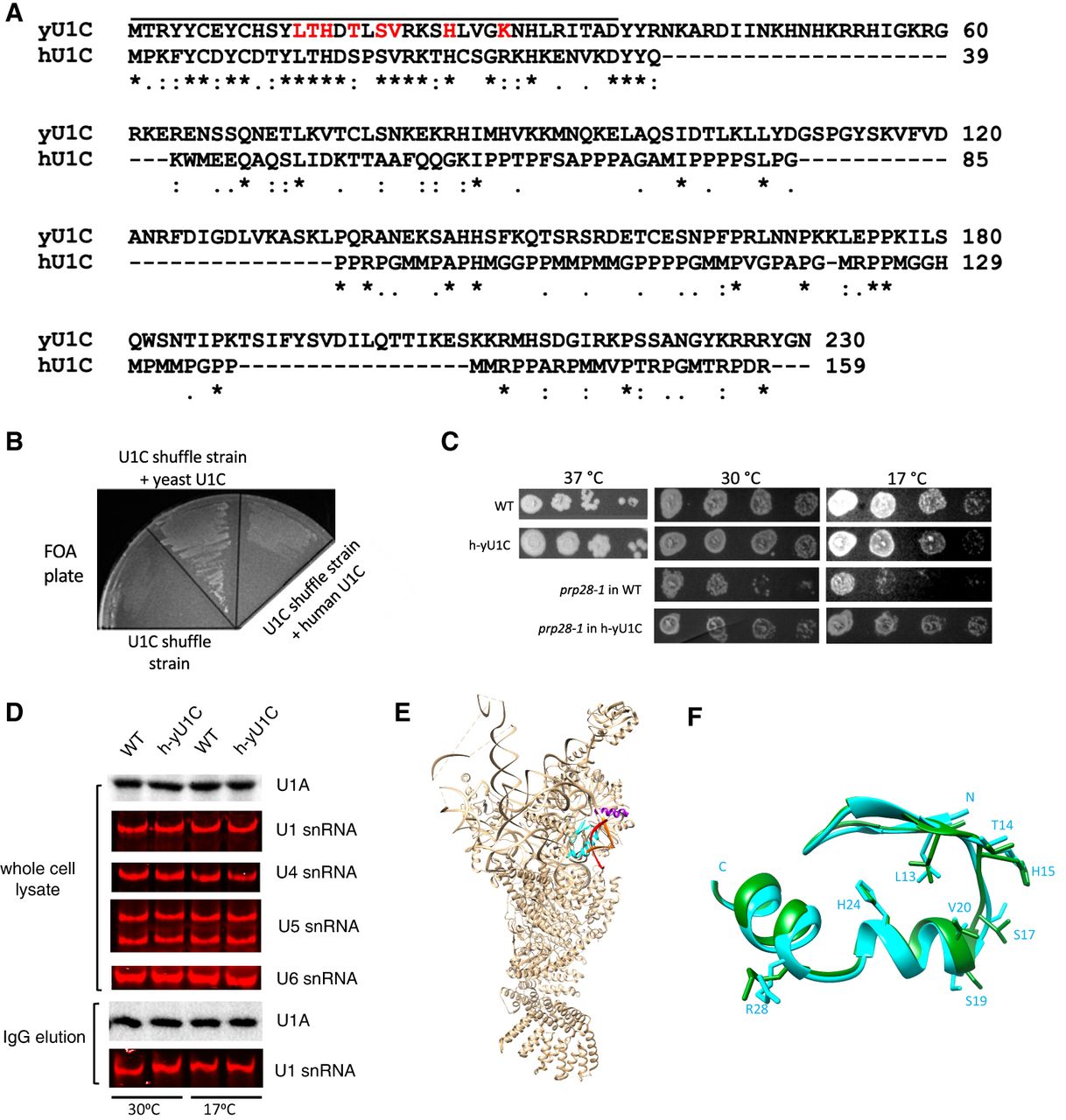
Humanization of yU1C leads to minor cold-sensitive (cs) growth defects. (A) Yeast and human U1C are highly conserved in the ZnF domain as demonstrated by sequence alignment using Clustal Omega (Sievers et al. 2011). (*) identical residues, (:) conserved residues, (.) less conserved residues, (‐‐) gaps. The line above the sequence indicates the yeast ZnF domain that was replaced with the corresponding human sequences. Red font indicates residues interacting with the U1–5′ ss RNA duplex in the cryo-EM structure of the yeast E complex (Li et al. 2019). (B) A yU1C shuffle strain (Schwer and Shuman 2014) alone, transformed with yU1C or transformed with human U1C, was plated on an FOA plate. Only the U1C shuffle strain transformed with yU1C grew. (C) Spot assay (10× serial dilution) of yeast strain with WT background, h-yU1C, prp28-1, and prp28-1 + h-yU1C at different temperatures. (D) U1A (probed by an anti-CBP antibody) and U1 snRNA (probed by solution hybridization) levels in whole-cell lysate and after IgG pull down using the TAP tag on U1A were similar between the WT and h-yU1C strain at both 30°C and 17°C. Other snRNAs serve as internal controls. (E) Overall structure of the U1 snRNPh-yU1C. The ZnF domain of U1C that was humanized is shown in cyan, the 5′ ss in red, the first 10 nt of U1 snRNA in orange, and the N-terminal helix of Luc7 in purple. (F) Superimposition of the ZnF domain of WT (green) and h-yU1C (cyan) backbone. Residues in h-yU1C that interact with the U1–5′ ss RNA duplex are shown in the stick model and labeled.




