


Cover image
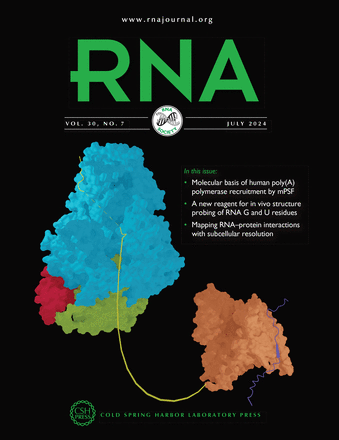
Recruitment of poly(A) polymerase to the human polyadenylation machinery (PDB id: 8R8R; Todesca S, Sandmeir F, Keidel A, Conti E. 2024. Molecular basis of human poly(A) polymerase recruitment by mPSF. RNA 30: 795–806. During human 3′ end processing of pre-mRNA, the four-subunit mammalian polyadenylation specificity factor (mPSF) recruits poly(A) polymerase α (PAPOA) to synthesize a poly(A) tail. A composite structural model reveals multiple interaction sites between mPSF subunits and PAPOA: The catalytic core of PAPOA (in orange) binds an unstructured region of the FIP1 subunit (in purple), while an extended C-terminal region of PAPOA (in yellow) engages with the CPSF160 subunit (in blue). The other mPSF subunits, CPSF30 and WDR33, are shown in red and green, respectively. Globular protein subunits are shown as surfaces, with peptides shown as a cartoon. The unmodeled region of the PAPOA C terminus is shown as a dashed line, and the unmodeled connection between the C-terminal peptide and the structured core is shown as a curve. Cover image created by Iuliia Iermak using Blender software with Molecular Nodes addon (doi:10.5281/zenodo.11264110).


Molecular Cloning
The New Edition
Buy Now and Save 30%
Paperback only
(limited time offer)

|
Molecular Cloning: A Laboratory Manual (Fourth Edition) |