


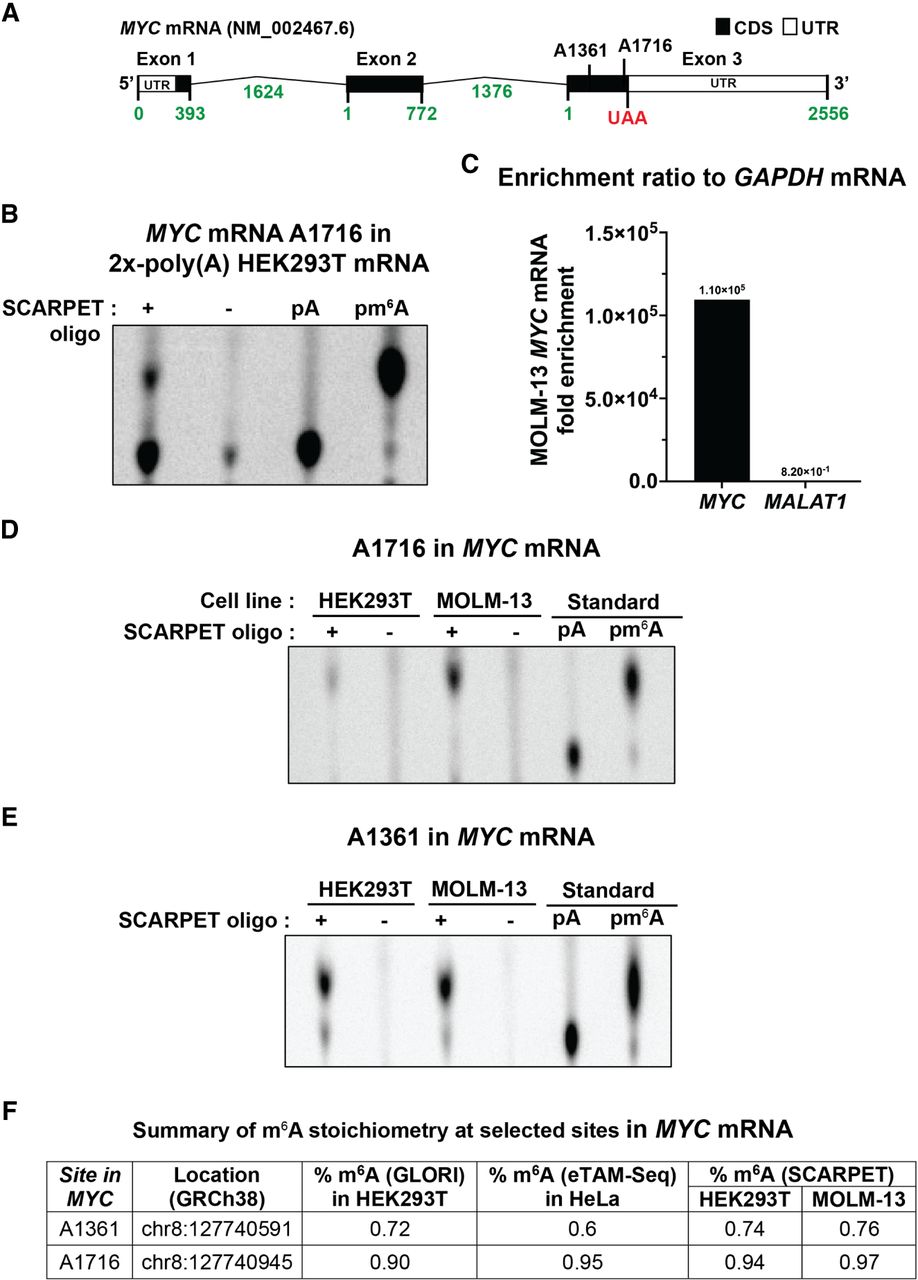
m6A stoichiometry at MYC mRNA m6A sites is largely similar in HEK293T and MOLM-13 cells. (A) Structure of MYC mRNA depicting A1361 and A1716 sites. Both sites have been previously detected by miCLIP m6A mapping (Linder et al. 2015). (B) SCARPET result for A1716 site in MYC mRNA using 2×-poly(A) HEK293T mRNA as the input. The m6A stoichiometry was found to be ∼20%. (C) The RT-qPCR-based fold enrichment of purified MYC mRNA from MOLM-13 cells relative to GAPDH mRNA in the pull-down with MYC mRNA targeting capture oligonucleotides compared to MALAT1 lncRNA which was used as a nonspecific control. (D,E) SCARPET results for MYC mRNA A1361 and A1716 sites using 1 ng of purified MYC mRNA from HEK293T and MOLM-13 cells as input for each site. For both A1361 and A1716, m6A stoichiometry was high (∼75% for A1361 and ∼95% for A1716) and similar between HEK293T and MOLM-13 cells. (F) Comparison of m6A stoichiometries at A1361 and A1716 sites measured by SCARPET to the levels measured by recent transcriptome-wide deamination-based methods, GLORI and eTAM-seq (Liu et al. 2023; Xiao et al. 2023). SCARPET results were remarkably similar to the results measured using these methods. 32P-labeled m6A and A nucleosides were run as TLC standards in B, D, and E.




