


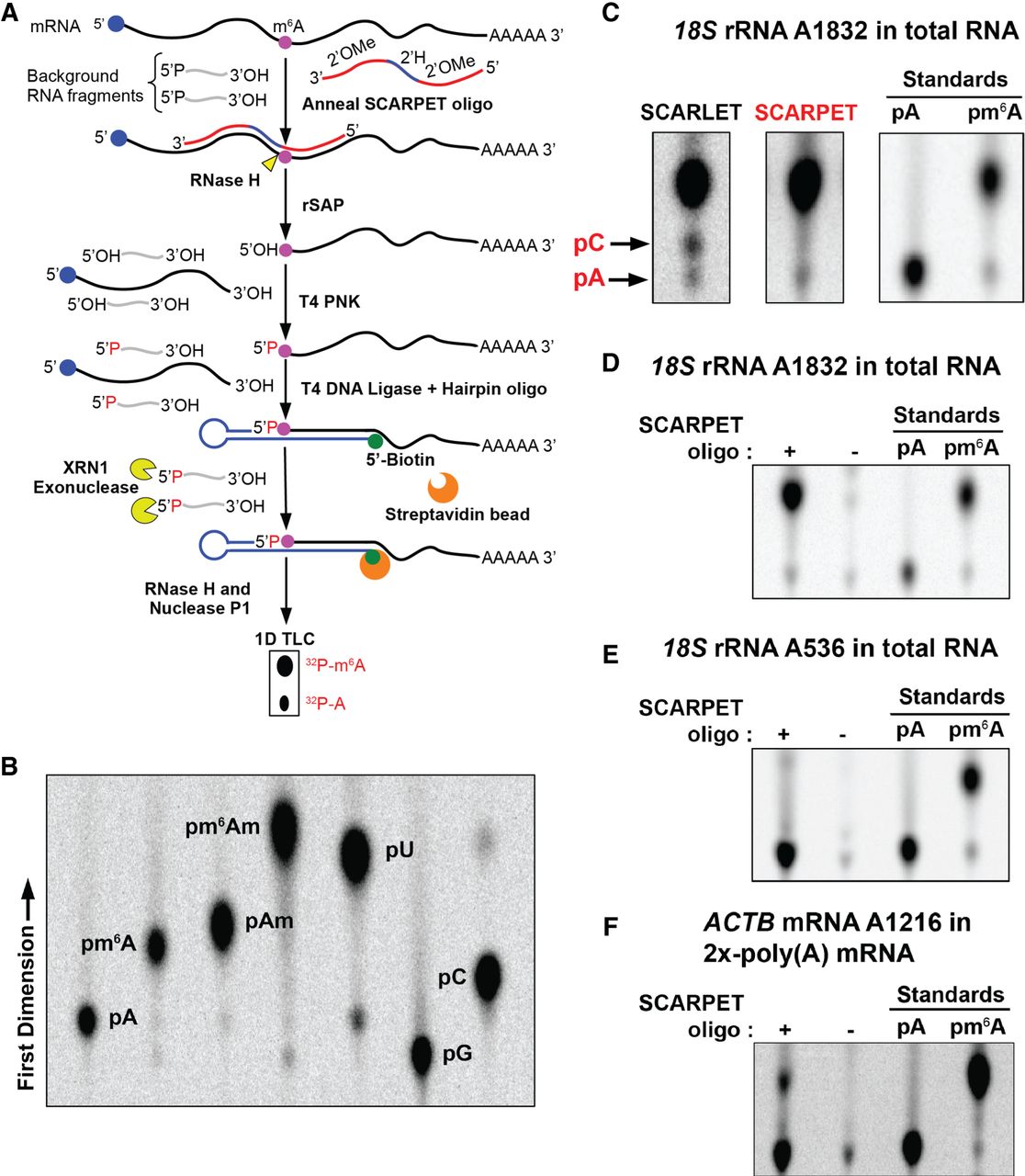
SCARPET reveals m6A stoichiometry at specific sites in RNA. (A) Schematic outline of SCARPET assay. (B) Diagram of one-dimensional thin-layer chromatography (1D-TLC) mobility maps of 5′-monophosphate nucleoside standards of adenosine (A) and its methylated derivates, uridine (U), cytosine (C), and guanosine (G) derived from synthetic RNA oligonucleotides after 32P-labeling, followed by nuclease P1 digestion. (C) Comparison of SCARLET and SCARPET results for determining the m6A stoichiometry at human 18S rRNA A1832 site in 1 µg HEK293T total RNA. The m6A stoichiometry measured by SCARPET and SCARLET assay was the same (∼98%), except the SCARLET assay showed an additional background spot corresponding to cytosine, which was not present with SCARPET. (D) The m6A signal is SCARPET oligonucleotide dependent. When the SCARPET oligonucleotide for human 18S rRNA A1832 is omitted, the m6A signal is completely lost. (E) SCARPET results for human 18S rRNA A536 site, which is not methylated but is found in a DRACH sequence context. SCARPET accurately revealed the m6A stoichiometry at the A536 site to be 0%. (F) SCARPET results for ACTB mRNA A1216 site in 2×-poly(A) HEK293T mRNA. The m6A stoichiometry at A1216 was ∼29%, which is consistent with previous measurements with SCARLET (Liu et al 2013). 32P-labeled m6A and A nucleosides were run as TLC standards in C–F.




