


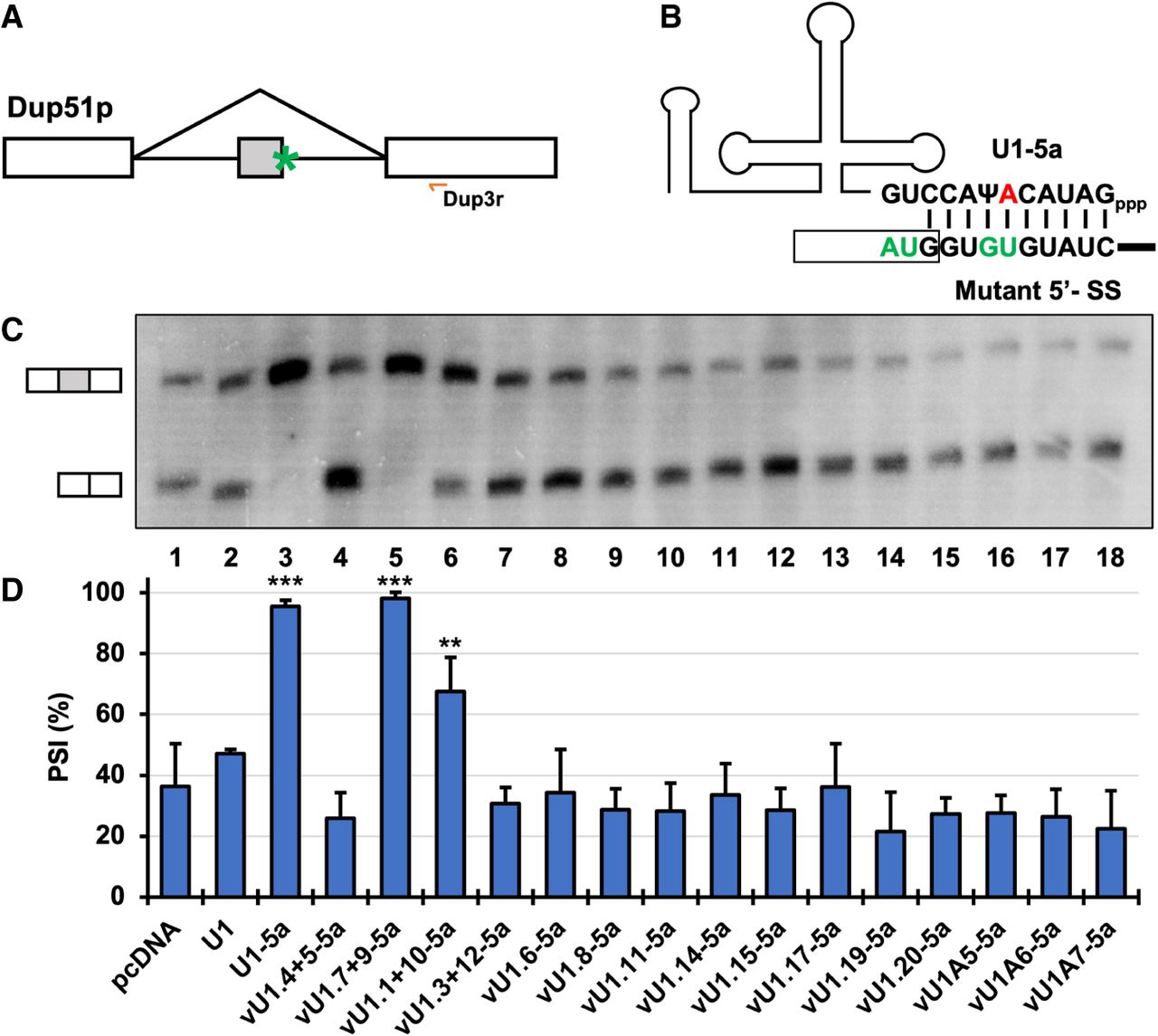
Primer extension analysis for measuring the capacity of vU1 snRNAs to facilitate splicing in HeLa cells. (A) Schematic diagram of the Dup51p minigene mRNA reporter indicating the location of the Dup3R primer that was used for primer extension. Dup51p pre-mRNA carries 5′-ss sequence mutations in intron 2 (indicated by the green asterisk) that cause exon 2 skipping. (B) Base-pairing of the 5′-region of the U1-5a snRNA to the 5′-ss of the Dup51p reporter. Changes to the intron 2 5′-ss sequence are shown in green. The U1-5a snRNA carries a compensatory U → A change at the fifth position (shown in red). (C) Primer extension analysis to monitor splicing of the Dup51p reporter pre-mRNA in HeLa cells coexpressing either pcDNA control or U1-5a plasmids expressing either the canonical or a vU1 snRNA. The full-length and exon 2 skipped Dup51p mRNA products are depicted to the left. (D) The percent spliced-in (PSI) value for exon 2 in the full-length Dup51 mRNA (±SD) is represented. Statistical significance was determined by comparisons to the wildtype control using t-test (lane 2). n = 3; (*) P < 0.05, (**) P < 0.01, (***) P < 0.001.




