


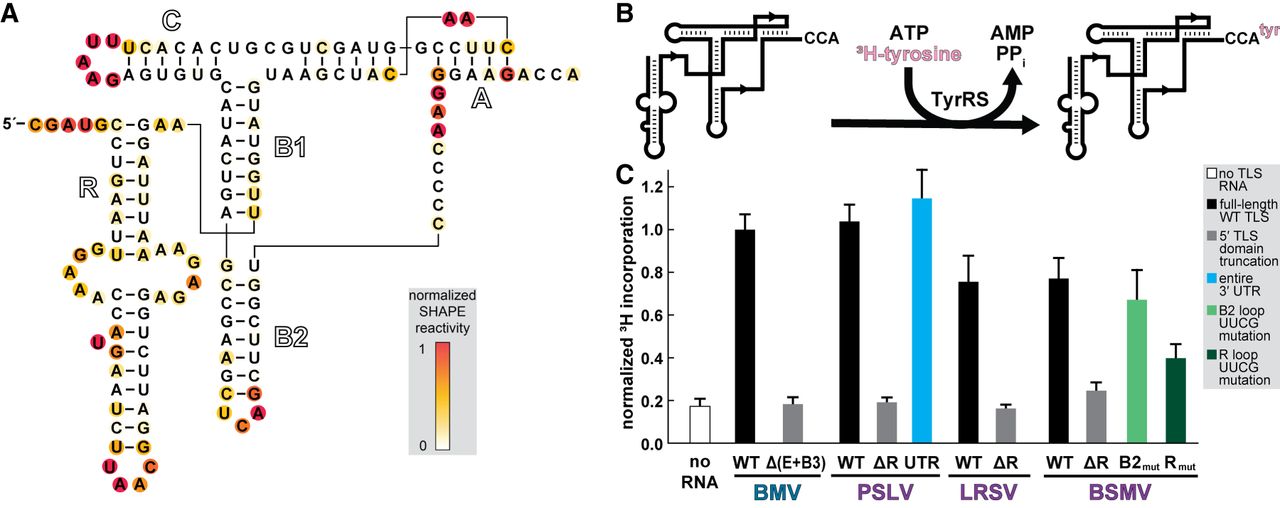
Structure and function of hordeivirus TLSTyr. (A) Chemical probing of the TLS representative from BSMV RNA1 using the SHAPE reagent NMIA. Reactivity was background subtracted and normalized according to the reactivity of loop regions in hairpin structures (not shown) flanking the TLS structure on both the 5′ and 3′ ends. See Supplemental Table S1 for complete sequence details and Supplemental Figure S1 for chemical probing of additional hordeivirus TLSTyr RNAs. (B) Schematic of in vitro aminoacylation assay using in vitro transcribed RNA, recombinantly expressed and purified TyrRS, and 3H-labeled tyrosine. (C) Relative activity of TyrRS on various TLSTyr RNAs as measured by the covalent addition of radiolabeled 3H-tyrosine at their 3′ termini after a 30-min incubation. 3H incorporation was normalized to the wild-type (WT) BMV TLSTyr construct, which had been previously tested (Bonilla et al. 2021). The truncated constructs Δ(E + B3) or ΔR are missing their respective 5′ domains, as indicated by the dashed box in Figure 1, and begin 4 nt before the B1 stem. The PSLV full 3′-UTR RNA includes the entire sequence after the stop codon. The BSMV TLS RNAs with mutations to the B2 and R stem–loops (B2mut and Rmut) contain UUCG tetraloops in place of the native loop sequence (see panel A for the WT BSMV TLSTyr sequence).




