


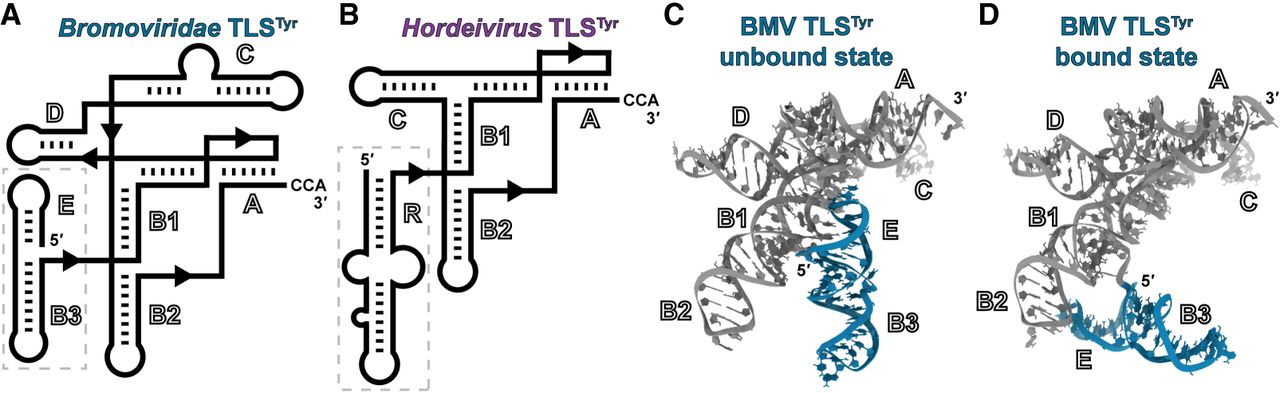
Domain architecture of tyrosine-accepting TLS RNAs. (A, B) Cartoon diagrams of the secondary structure of the tyrosine-accepting tRNA-like structures (TLSTyr) from the (A) anulavirus, bromovirus, cucumovirus, and oleavirus genera of Bromoviridae and (B) hordeivirus genus of Virgaviridae. Helical elements are lettered according to previous literature (Ahlquist et al. 1981; Solovyev et al. 1996; Savenkov et al. 1998; Bonilla et al. 2021). The respective 5′ domains, consisting of the (A) E and B3 stem–loops or (B) R stem–loop, are boxed in gray. The secondary structure of the R domain of the hordeivirus TLSTyr was not experimentally probed before this study; the putative structure is shown. (C, D) Structural model of the BMV TLS in the C unbound (RNA-only; PDB ID: 7SAM) and (D) bound (RNA-tyrosine synthetase complex; PDB ID: 7SCQ) states with each domain labeled. The synthetase is not shown for clarity.




