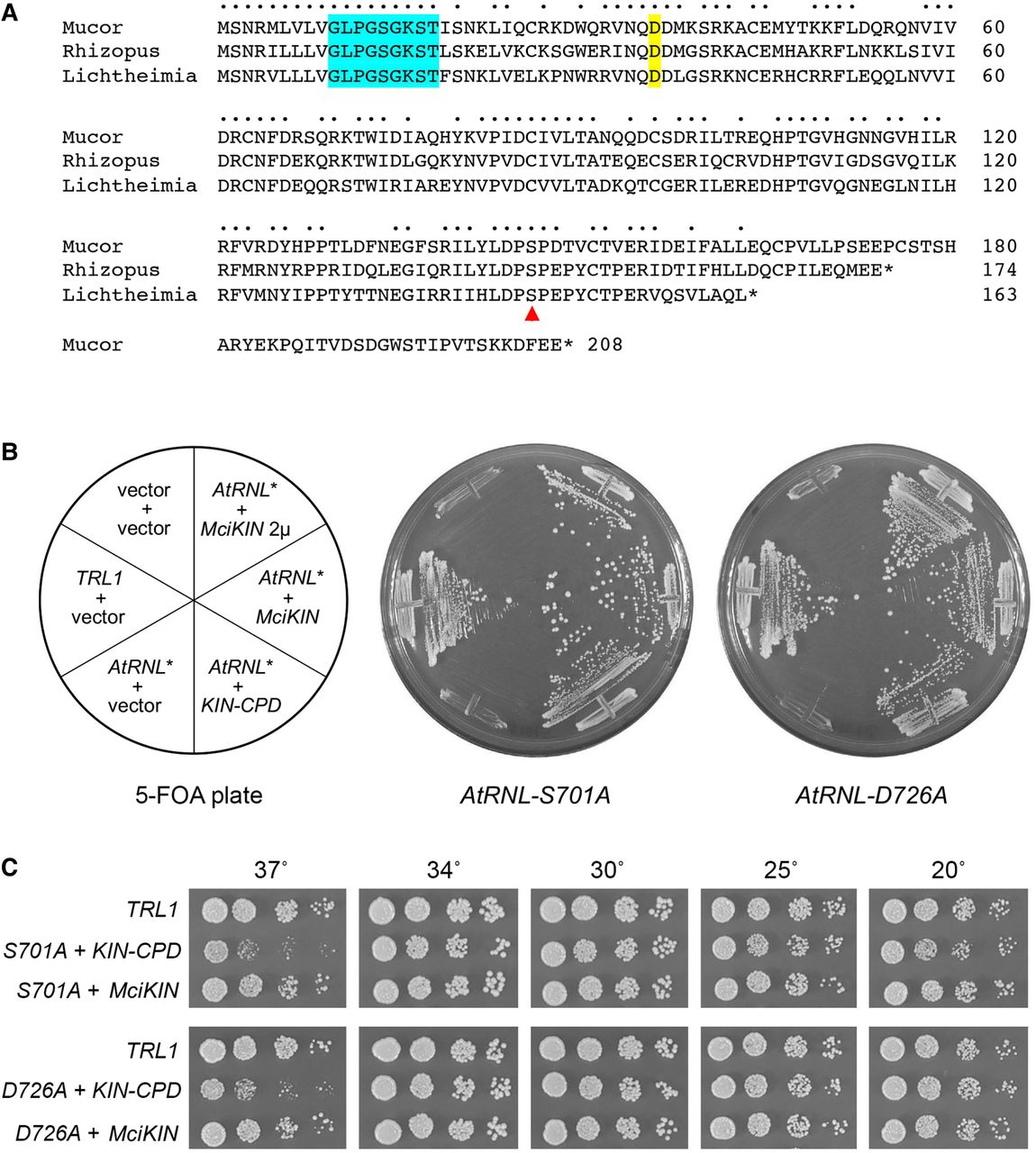
Mucorales encode a stand-alone kinase active in tRNA splicing in vivo. (A) Alignment of the primary structures of candidate polynucleotide kinases from M. circinelloides (GenBank EPB87039.1), R. azygosporus (GenBank RCH95593.1), and L. corymbifera (GenBank CDH52573.1). Positions of side chain identity/similarity are indicated by dots. The signature P-loop motif that engages the NTP phosphate donor is highlighted in cyan. A conserved aspartate implicated in the activation of the polynucleotide 5′-OH nucleophile is shaded in yellow. A conserved serine (Ser146), implicated in the present study as a determinant of the GTP donor specificity of the Mucorales kinases, is denoted by a red arrowhead. (B) Complementation of S. cerevisiae trl1Δ was assayed by plasmid shuffle (Sawaya et al. 2003; Schwer et al. 2004). Yeast trl1Δ p360-TRL1 (URA3 CEN) cells were cotransformed with: (i) an empty CEN HIS3 vector and an empty CEN TRP1 vector (negative control); (ii) an empty CEN HIS3 vector and a CEN TRP1 plasmid encoding S. cerevisiae TRL1 (positive control); (iii) an empty CEN HIS3 vector and a CEN TRP1 plasmid expressing either of two kinase-defective AtRNL* mutants of the Trl1-like plant tRNA ligase (AtRNL-S701A or AtRNL-D726A); (iv) the CEN TRP1 AtRNL* plasmid and a CEN HIS3 plasmid expressing the KIN-CPD module of S. cerevisiae TRL1 (aa 389–827); and (v) the CEN TRP1 AtRNL* plasmid and a CEN HIS3 or 2µ HIS3 plasmid expressing MciKIN. Trp+ His+ transformants were selected at 30°C and then streaked on agar medium containing 0.75 mg/mL FOA. The plates were photographed after 4 days at 30°C. (C) Aliquots (3 µL) of serial fivefold dilutions of FOA-resistant trl1Δ strains expressing the indicated genes were spotted on YPD agar plates and incubated at 20, 25, 30, 34, and 37°C. Photographs of the plates are shown.