


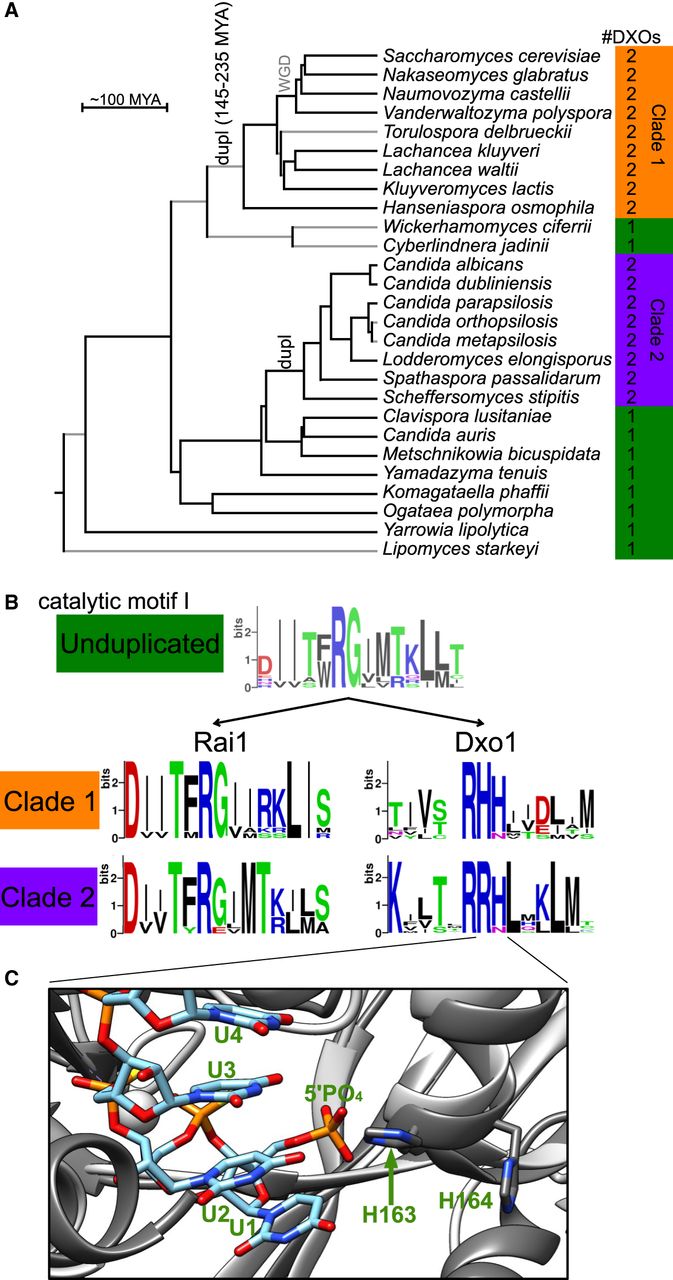
The independent duplication of Dxo1/Rai1 in two different clades was followed by parallel sequence changes. (A) 44 Dxo1/Rai1 sequences from 17 budding yeast species with duplicated genes and ten species with a single nonduplicated gene were identified, revealing that the species with duplicated genes fall into two clades (highlighted in orange and purple), indicating two independent gene duplications. The tree is derived from Li et al. (2021). Branch lengths in black are proportional to divergence time estimated in timetree.org. For the branches in gray, no divergence time estimate is available. WGD indicates a well-characterized whole-genome duplication that occurred after and independent of the RAI1/DXO1 duplication. (B) The 44 sequences were aligned using Clustal. The alignment was then split into five sets of sequences: nonduplicated (top center), Dxo1s from clades 1 and 2 (right), and Rai1s from clade 1 and 2 (left). Sequence logos were generated for each of the five subsets. Shown is a sequence logo of “Motif I” of the active site showing that a conserved R/HH motif arose in the Dxo1 of both clades, and that a conserved D became more conserved in the Rai1 of both clades. (C) The R/HH motif of Dxo1 is located in close proximity to the 5′ monophosphorylated RNA. Shown are superimposed structures of K. lactis Dxo1 (dark gray; PDB# 4GPS) and mouse DXO that is bound to an uncleavable substrate analog (5′ monophosphate oligo U with phosphorothioate at the scissile bond; light gray; PDB#4J7M).




