


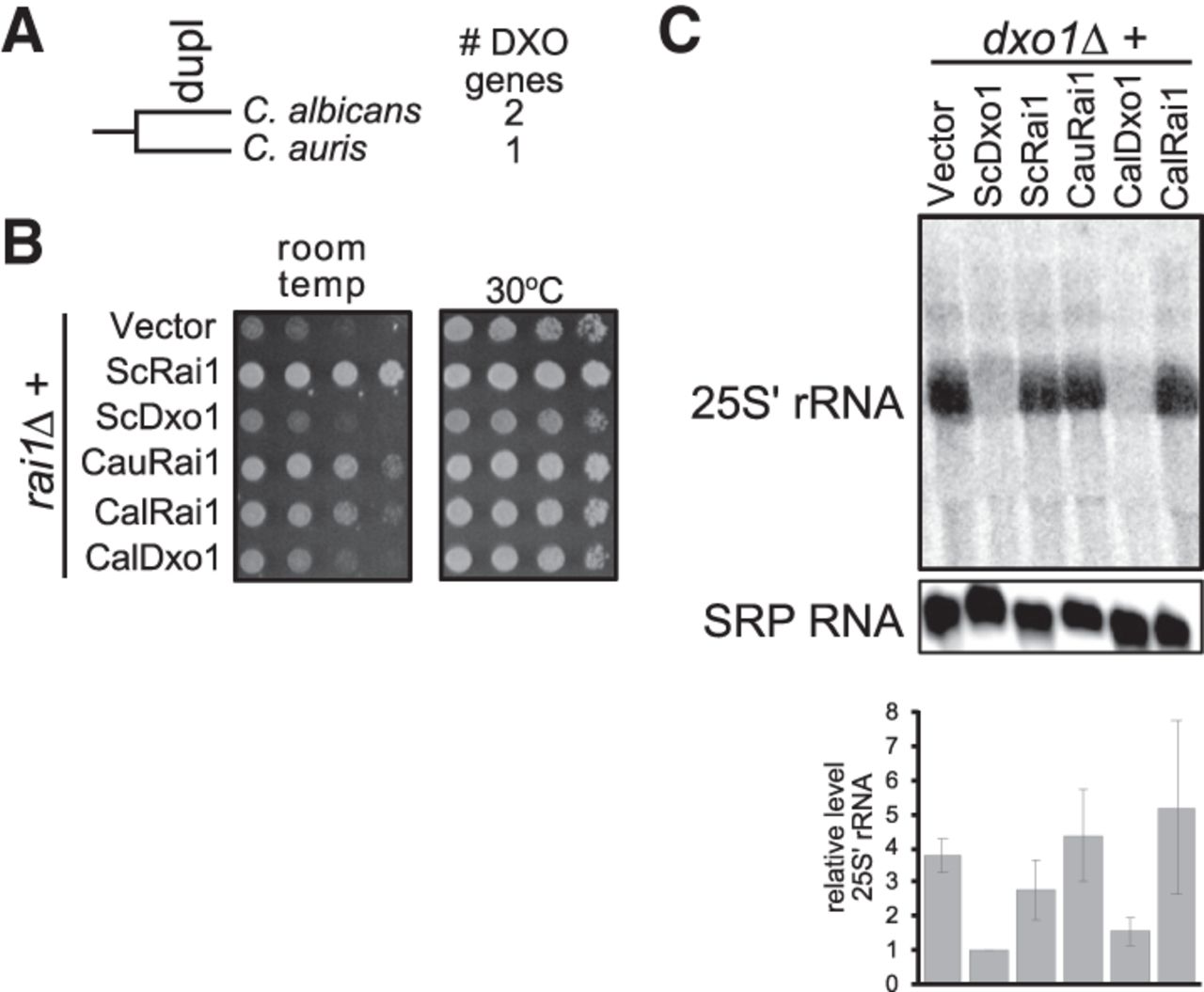
Dxo1/Rai1 is independently duplicated in C. albicans and Dxo1 also acquired 25S′ to 25S processing capacity. (A) Dxo1 and Rai1 are duplicated in C. albicans, but not in C. auris, suggesting that duplication occurred in an ancestor of C. albicans after divergence form C. auris. Note that although the two species are placed in the Candida genus, C. auris is distantly related to true Candida species and more closely related to Clavispora lusitaniae (formerly Candida lusitaniae, Fig. 5). (B) The C. albicans RAI1 gene and the C. auris nonduplicated gene can complement rai1Δ growth phenotype and thus carryout Rai1 function. Shown is a growth assay of a rai1Δ strain that expressed Rai1 or Dxo1 homologs (from plasmids pRS416, pAv1820, pAv1804, pAv1817, pAv1818, and pAv1816 from top to bottom). (C) Dxo1 function arose in C. albicans Dxo1 after the duplication. The dxo1Δ strain was transformed with pRS416, pAv1804, pAv1820, pAv1817, pAv1816, and pAv1818 (left to right). Shown is a representative northern blot of the 25S′ rRNA and the RNA subunit of the signal recognition particle (SRP; loading control) and the quantitation of two biological replicates.




