


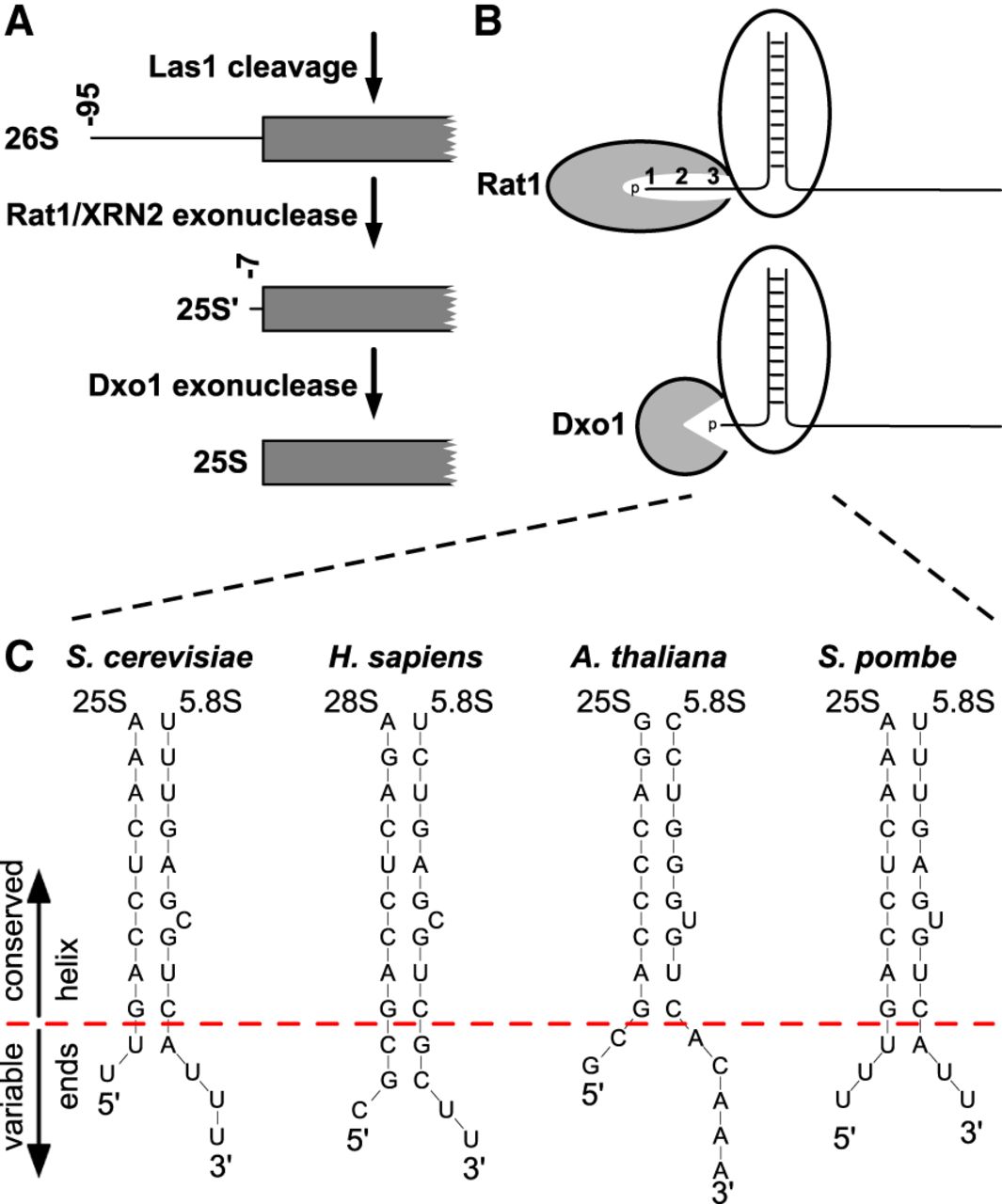
A short single-stranded 5′ end of large rRNA is a conserved feature across kingdoms. (A) 5′ end processing of 25/28S rRNA requires cleavage by Las1, at −95 in S. cerevisiae, followed by exonucleolytic digestion by Rat1 and then by Dxo1. (B) Rat1 family enzymes are processive, at least in part, because they require three single-stranded nucleotides of the 5′ end that mediate continuous binding of the substrate between cycles of catalysis. Although the active site for mouse DXO can accommodate three to four single-stranded nucleotides, whether this is true for Dxo1 is unclear. However, Dxo1 is a distributive enzyme that does not remain associated with the substrate between cycles of catalysis and thus does not require continuous association with an unstructured 5′ end. (C). The 5′ end of the large (25S or 28S) rRNA as defined by the analysis in Figure 1 is base-paired with the 3′ end of 5.8S rRNA. Although there is some variation, the large rRNA has a 1 to 2 nt single-stranded 5′ overhang. There is no obvious reason why the precise 25S 5′ end maturation requires Dxo1 in S. cerevisiae, but not the orthologs in H. sapiens, A. thaliana, or S. pombe.




