


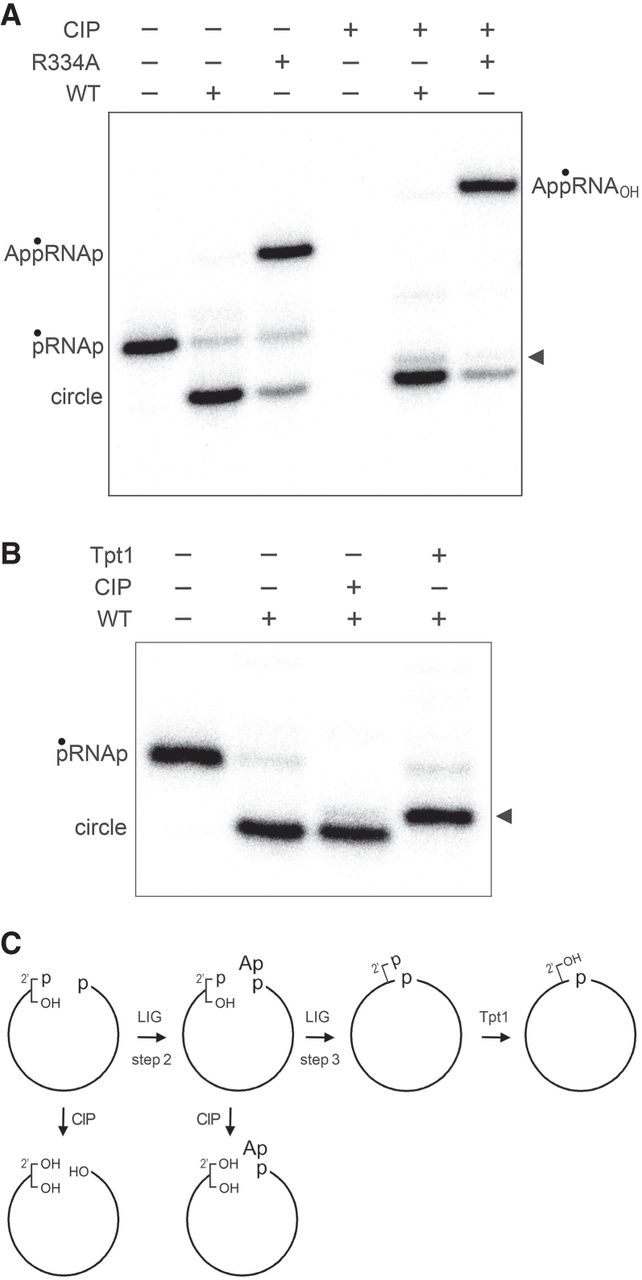
Analysis of the ligation reaction products. (A) Product analysis via treatment with CIP (calf intestine alkaline phosphatase). Ligation reactions containing 0.5 pmol 5′ 32P-labeled pRNA2′p and 10 pmol CthLIG (where indicated by +) were incubated at 37˚C for 30 min. The mixtures were then incubated for 10 min at 37˚C with 10 U CIP (purchased from NEB) where indicated by + above the lanes. The mixtures were quenched and then analyzed by urea-PAGE. (B) Product analysis via treatment with Tpt1 (RNA 2′-phosphotransferase). Ligation reactions containing 0.5 pmol 5′ 32P-labeled pRNA2′p and 10 pmol CthLIG (where indicated by +) were incubated at 37˚C for 30 min. The mixtures were then incubated for 30 min at 37˚C with 5 pmol Runella slithyformis Tpt1 (RsTpt1) and 1 mM NAD +. The mixtures were quenched and then analyzed by urea-PAGE. The 5′ 32P-phosphate is denoted by filled circle (•) in panels A and B. The ligated circular RNA with a 2′-OH splice junction formed after treatment with Tpt1 is indicated by the arrowhead at right in panels A and B. (C) Schematic of steps 2 and 3 of the ligation reaction and the species generated by treatment with CIP and Tpt1.




