


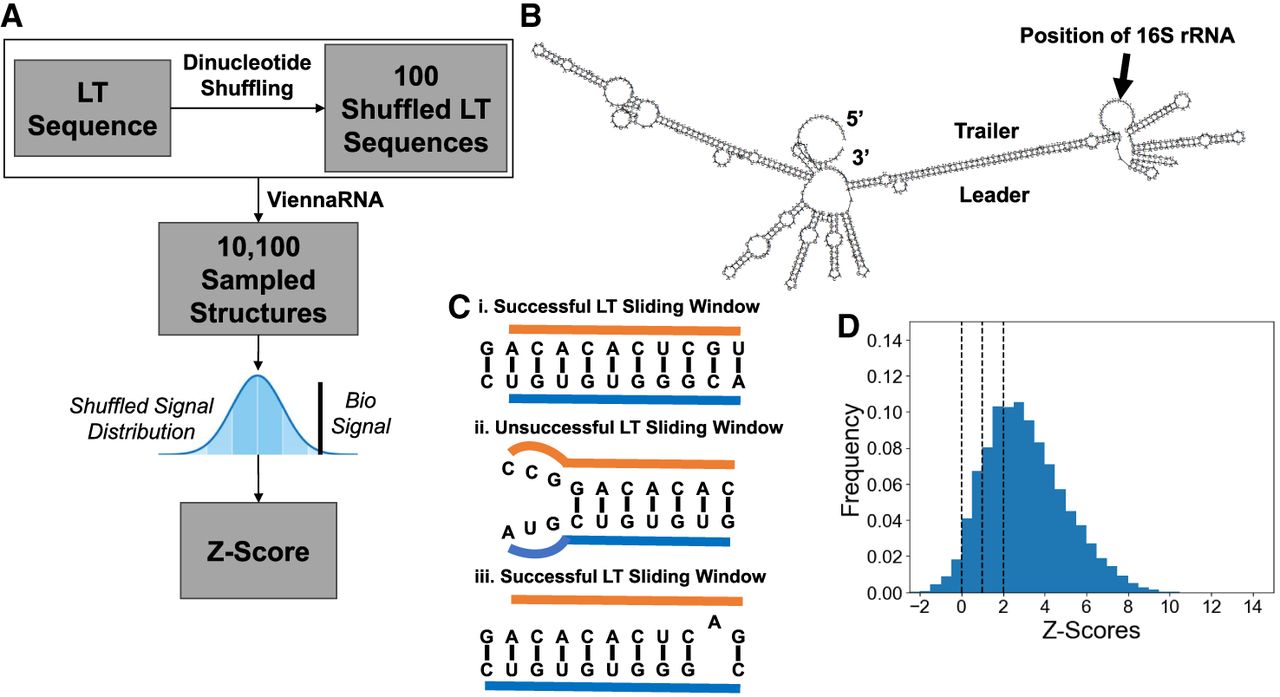
A shuffling method identifies LT helices of 16S rRNA. (A) For each LT sequence, dinucleotide frequency preserved shuffling was applied 100 times, generating 101 total sequences. For each sequence, the ViennaRNA package was used to sample 100 secondary structures. For each of the 10,100 generated structures, an SW matching approach was applied to determine the LT stem signal, which was averaged over the 100 structures sampled for each sequence to obtain the sequence's stem signal. The average biological sequence signal was compared to the mean and standard deviation of the shuffled sequence signal distribution to determine the z-score, representing the relative strength of an LT stem forming in the biological sequences against a random background. (B) An example biological LT structure of 16S rRNA of E. coli, where the sequence corresponding to the mature rRNA has been replaced by NNNNNNNNNN (C) (i) a successful LT SW, with 10 of 10 positions containing an LT bp, (ii) an unsuccessful LT SW, where only seven of 10 positions contain an LT bp, (iii) a successful LT SW, where nine of 10 positions contain an LT bp. (D) The distribution of z-scores for all 17,942 16S LT sequences, where black dotted lines are drawn at z-scores of 0, 1, and 2; used to classify evidence for LT stems as absent, weak, intermediate, and strong.




