


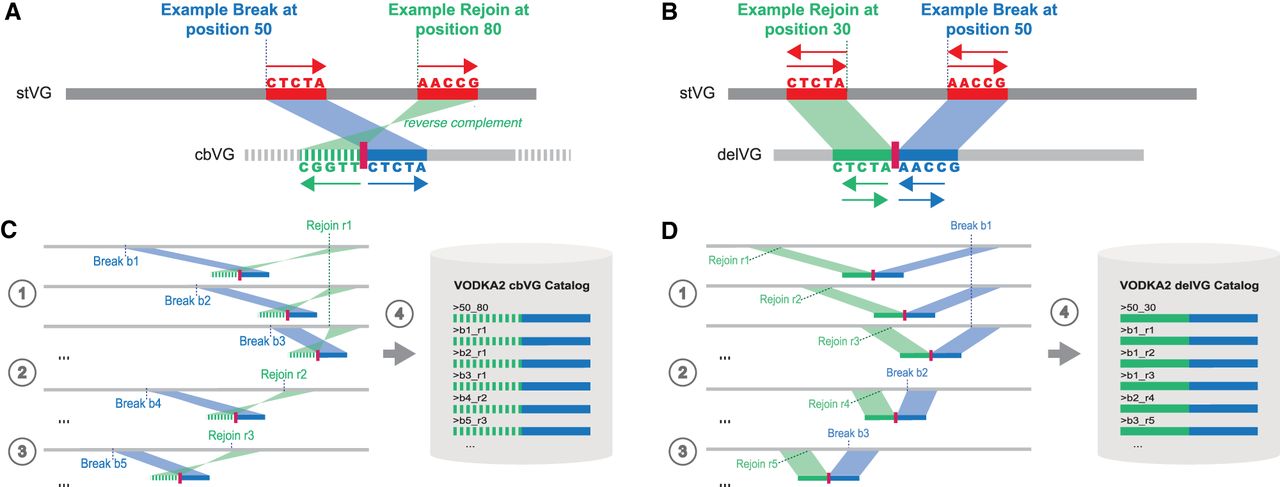
VODKA2 catalog generation process. (A) Example of a single iteration for a copy-back viral genome (cbVG) junction region sequence generation. The gray and red line represents the reference sequence of an imaginary standard viral genome (stVG) used to extract 5 nt downstream from break (CTCTA) and the reverse complement of the 5 nt downstream from rejoin (AACCG) to generate the corresponding cbVG junction sequence (CGGTTCTCTA). The cbVG hypothetical sequence is shown in lighter gray and the dashed lines represent the two complementary ends. Arrows above and underneath the sequence portions show the orientation of the extracted sequences. (C) The VODKA2 cbVG catalog generation algorithm proceeds as follows: (1) Identify all possible Break positions that could rejoin at Rejoin r1; (2) next, identify all possible Break positions that could rejoin at Rejoin r2; (3) next, identify all possible Break positions that could rejoin at Rejoin r3 and continue for all possible combinations; (4) write the junction reference sequences to a file in FASTA format. (B) Example of a single iteration for a deletion genome (delVG) junction region sequence generation. The gray and red line represents the reference sequence of an imaginary standard viral genome (stVG) used to extract 5 nt downstream from break (AACCG) and the 5 nt upstream of rejoin (CTCTA) to generate the corresponding delVG junction sequence (CTCTAAACCG). The delVG hypothetical sequence is shown in lighter gray. Sequence orientation of the two extracted sequence portions must be in the same orientation, which can be either both forward or both reverse as shown by the arrows. (D) The VODKA2 delVG catalog generation algorithm proceeds as follows: (1) Identify all possible Rejoin positions that could break at Break b1; (2) next, identify all possible Rejoin positions that could break at Break b2; (3) next, identify all possible Rejoin positions that could break at Break b3 and continue for all possible combinations; (4) write to a file the junction reference sequences as they are generated (in FASTA format).




