


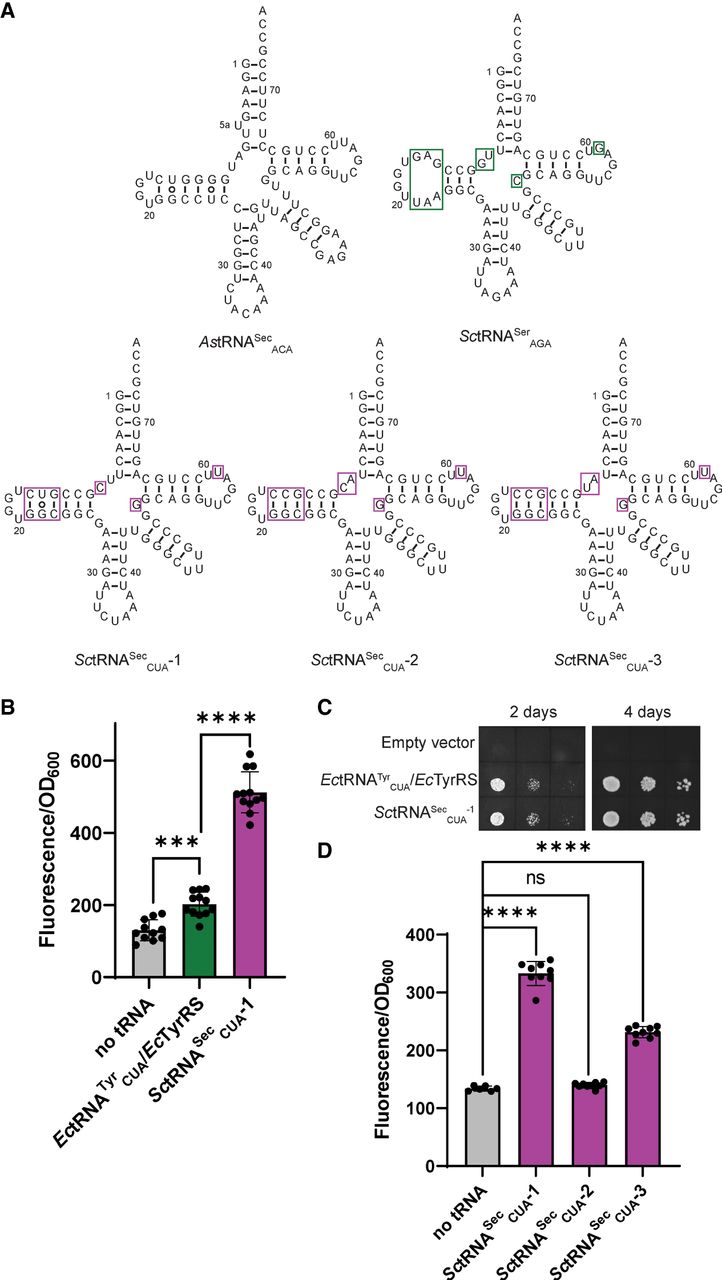
Design of tRNAs for Sec translation in S. cerevisiae. (A) Secondary structure representation of SctRNASec designed from replacing regions of SctRNASer with features from AstRNASec (outlined in purple). As the enzymes used in this study originated from a small group of Aeromonas species which irregularly utilize the ACA anticodon (and UGU codon pair) and thrive at a wide temperature range (Pfeiffer et al. 2018), the AstRNASec shown has an AGA anticodon. (B) sfGFP-S2Am readthrough assay found SctRNASecCUA-1/AsSelA (purple) to be a strong suppressor compared to an E. coli tRNATyrCUA/TyrRS pair (green) (P < 0.0001, n = 12). (C) Gal4-R110Am assay showed similar cellular growth of S. cerevisiae in the absence of uracil for SctRNASecCUA-1 compared to an E. coli tRNATyrCUA/TyrRS pair. (D) sfGFP-S2Am readthrough assay compared all SctRNASecCUA variants with AsSelA, highlighting the highest suppression levels with SctRNASecCUA-1.




