


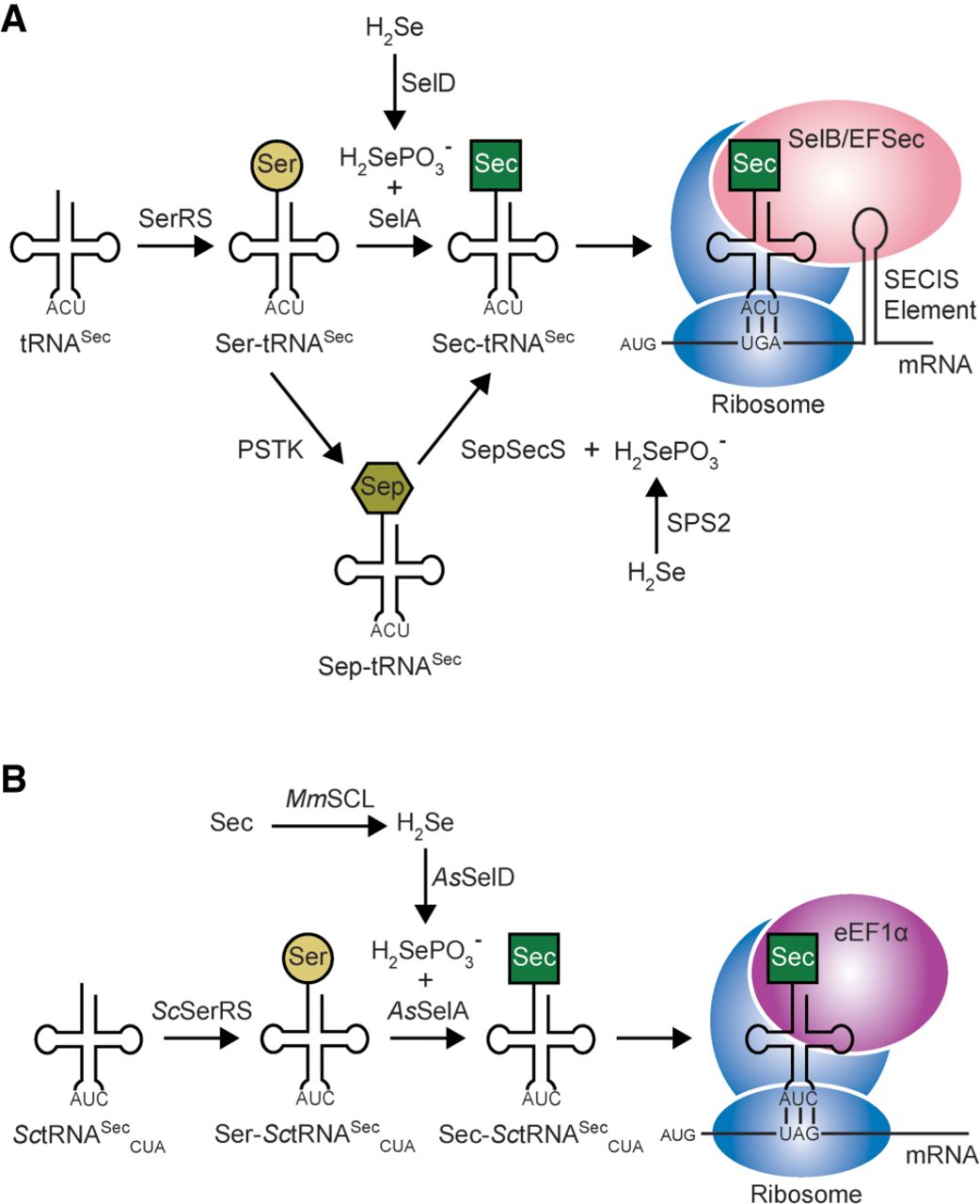
Natural and synthetic Sec translation systems. (A) Natural Sec translation in all domains of life initiates with serylation of tRNASec by SerRS. Conversion to Sec occurs in a single step in bacteria (via SelA) or two steps in archaea and eukaryotes (Ser to Sep by PSTK and Sep to Sec by SepSecS). Selenophosphate (H2SePO3−) is generated from SelD (in bacteria) or SPS2 (in eukaryotes) to support the conversion to Sec. Sec-tRNASec then recodes a UGA codon upstream of a stem–loop RNA structure (SECIS element) by a specialized elongation factor (SelB or EFSec). (B) Synthetic Sec translation system in S. cerevisiae (Sc) initiates with an engineered SctRNASec to recode UAG codons. Initial serylation occurs with endogenous ScSerRS before conversion to Sec by A. salmonicida (As) SelA. Selenophosphate is provided through breakdown of free Sec to selenide by M. musculus (Mm) SCL and then selenide to selenophosphate by AsSelD. Sec-SctRNASec is then recognized by eukaryotic EF1α and installs Sec at UAG codons.




