


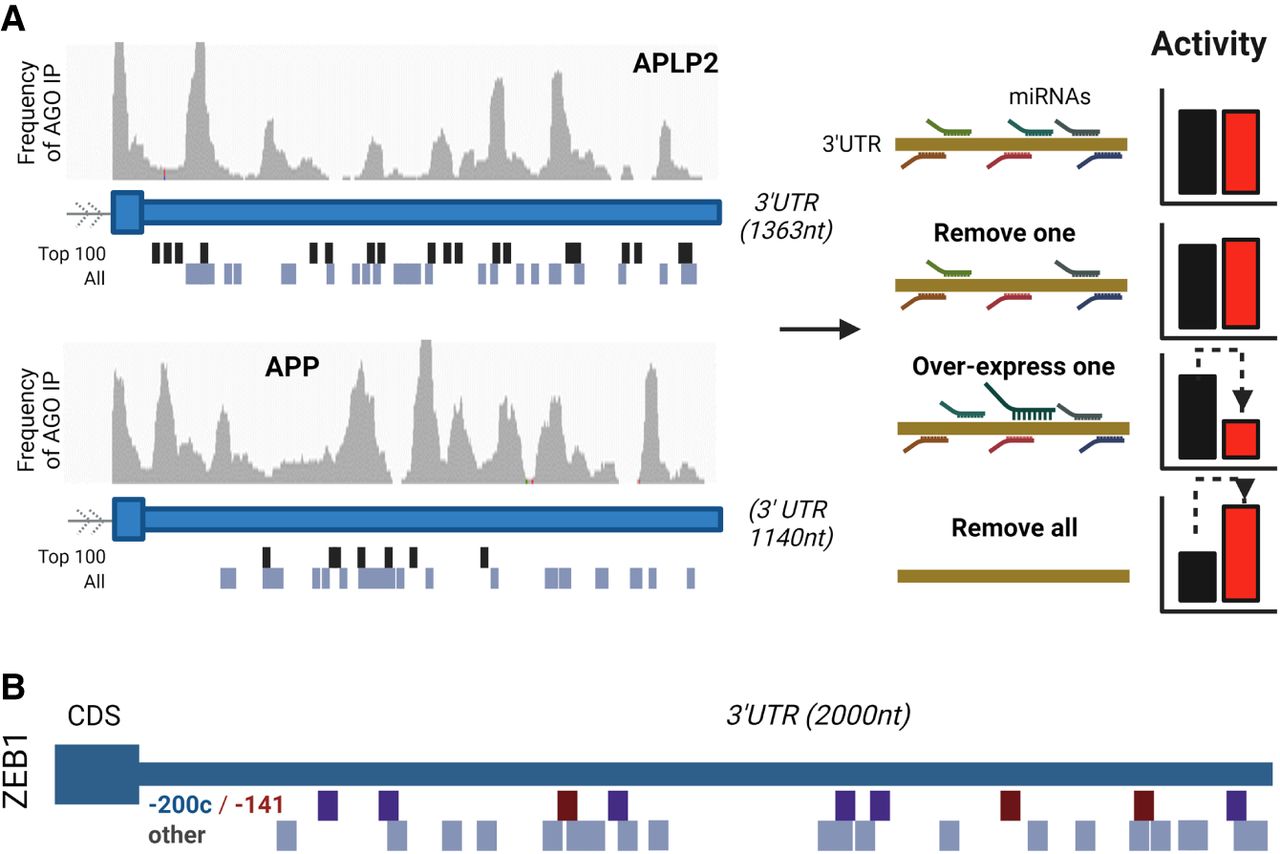
(A) MicroRNA-guided AGO interaction sites identified by AGO-HITS-CLIP (high-throughput sequencing, cross-linked immunoprecipitation) indicate multiple sites of miRNA binding. Black bars indicate predicted binding sites for miRNAs that are in the top 100 most expressed miRNAs in MDA-MB-231 cells (in which the experiment was performed). Gray bars indicate all other candidate binding sites. Canonical binding sites were predicted by TargetScan. The crowd-control hypothesis states that each of the interacting miRNAs are likely to have minimal effects by themselves, but collectively can have a meaningful impact on gene expression. This can be recapitulated by any individual miRNA when expressed at supraphysiological levels. (B) Predicted miRNA binding sites within the ZEB1 3′UTR indicate unusually strong targeting by the miR-200 family. Mir-200 encompasses five family members with two different targeting specificities. miR-200c/-200b/-429 (blue bars) have six predicted sites. miR-141/-200a (red bars) have three predicted sites. Light gray bars indicate potential binding sites for an additional 19 miRNAs (from among the 86 miRNAs that are expressed at a level >0.1% of all miRNAs in HMLE cells—an epithelial cell line in which ZEB1 is actively repressed). A single predicted binding site is present in the ZEB1 3′UTR for 16 of these miRNAs. Two predicted binding sites are present for each of the remaining three miRNAs.




