


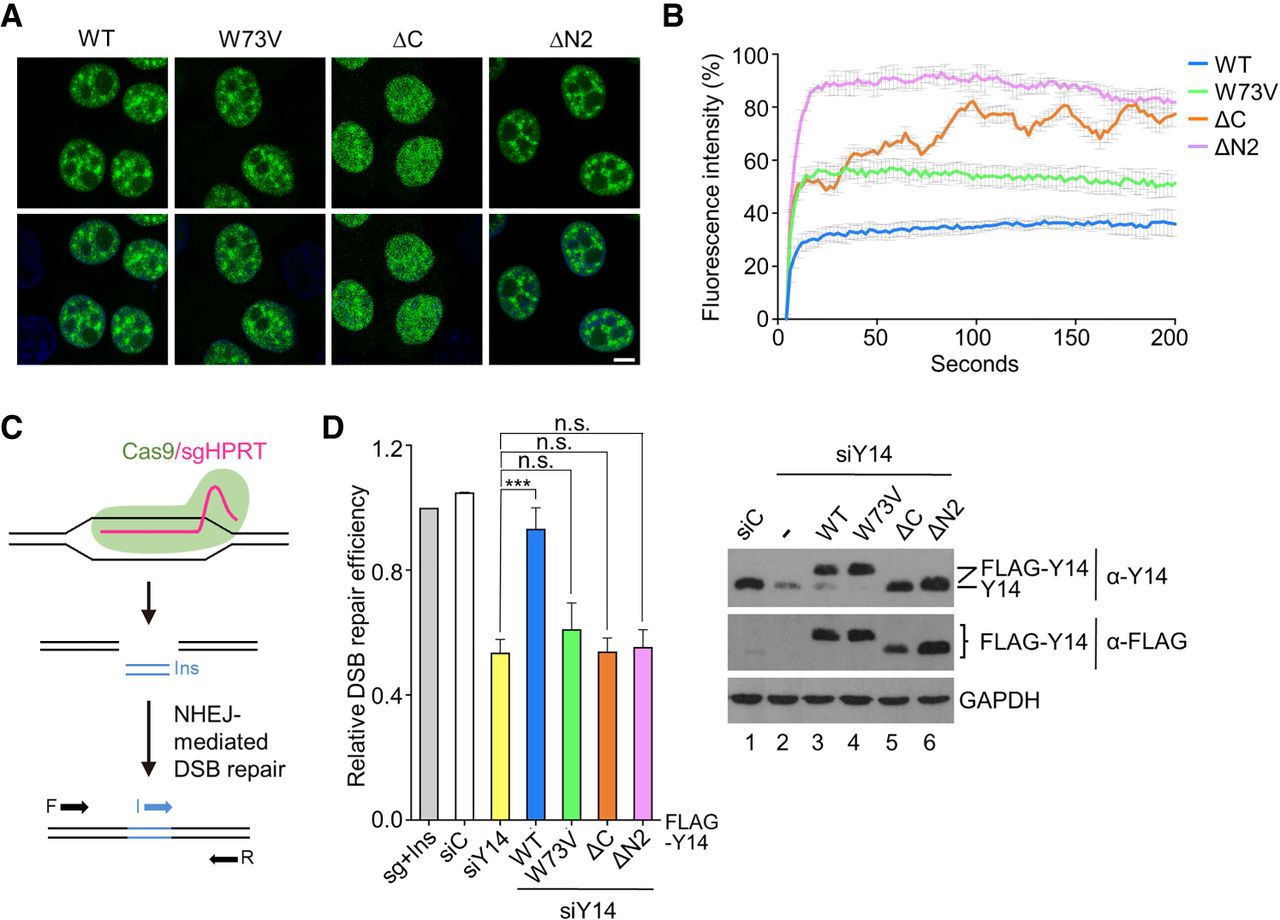
Co-phase separation of Y14 and RNA is essential for DNA damage repair. (A) U2OS cells were transfected with an expression vector encoding GFP-tagged Y14 (wild-type, W73V, ΔC, and ΔN2). Confocal microscopy images showing their subnuclear localization. Bar, 10 µm. (B) Graph showing the recovery kinetics of FRAP analysis of GFP-Y14 (as in A). Percentage represents normalized fluorescence intensity (to that of the first post-bleach value). Mean and standard-deviation values were calculated for 18–24 samples. (C) Diagram showing the design of NHEJ-mediated repair of DSBs. DSB was induced by transfection of cells with the Cas9/single guide RNA (sgHPRT) vector. Incorporation of the double-stranded oligonucleotide “Ins” into the DSB sites was measured by PCR using the indicated primers. (D) HeLa cells were transfected with Cas9/sgHPRT (all samples) without or with the indicated siRNA and siRNA-resistant FLAG-Y14 (wild-type or mutant). Genomic DNA was recovered for qPCR using the primer sets I/R and F/R; the latter was used for normalization. Bar graph shows relative PCR products (sg + Ins was set to 1), representing DSB repair efficiency (mean ± SD; N = 2–4; (***) P < 0.001; n.s., no significant difference). Immunoblotting was performed using anti-Y14, which detected endogenous Y14 and overexpressed FLAG-Y14, and anti-FLAG, which detected FLAG-Y14 (endogenous and FLAG-Y14ΔC at the same position on SDS-PAGE). GAPDH was used as the control.




