


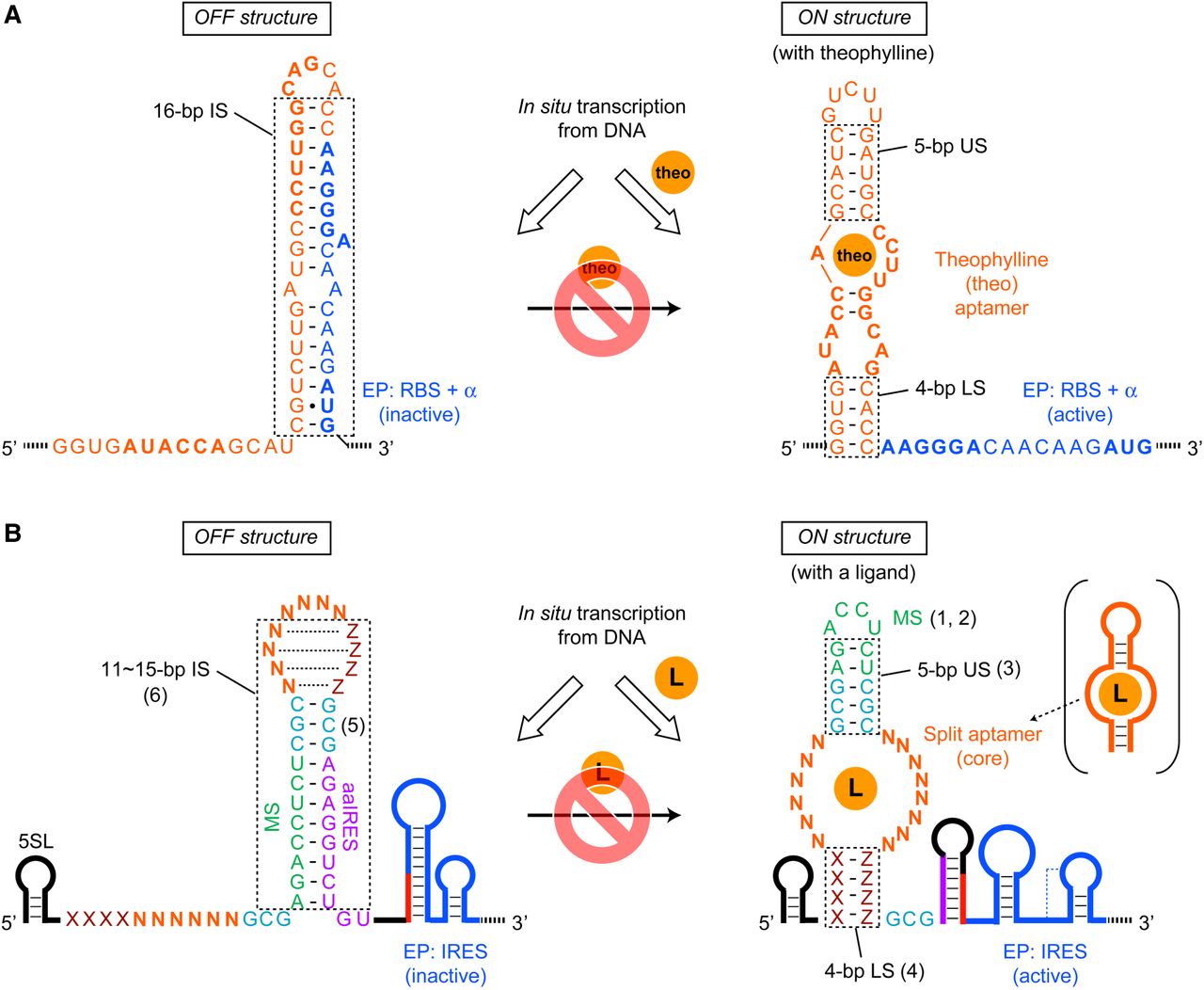
Rational design of eukaryotic kt-ON-riboswitches with reference to a bacterial kt-ON-riboswitch. (A) Predicted secondary structures of a highly efficient bacterial kt-ON-riboswitch that regulates translation initiation in response to theophylline (riboswitch C). The aptamer core sequences and the EP core sequences (i.e., the RBS and the start codon) are shown in bold. A 5′ region of the aptamer sometimes forms a weak secondary structure in the OFF structure, depending on the upstream sequence. (B) Predicted secondary structures of rationally designed eukaryotic kt-ON-riboswitches that regulate translation initiation mediated by the PSIV IRES. The IS length varies depending on the 3′-side LS sequence (ZZZZ), which hybridizes to the 5′-side LS (XXXX) in the ON structure. The secondary structures of the IRES are roughly simplified. The red bars represent the 8-nt aIRES (see Supplemental Fig. S2). The purposes of the 5′ terminal stem–loop structure (5SL) are to enhance T7 transcription, stabilize transcripts, and prevent the eukaryotic canonical translation. A schematic of the original splittable aptamer is shown in parentheses. The numbers in parentheses correspond to those of the design procedure in the main text.




