


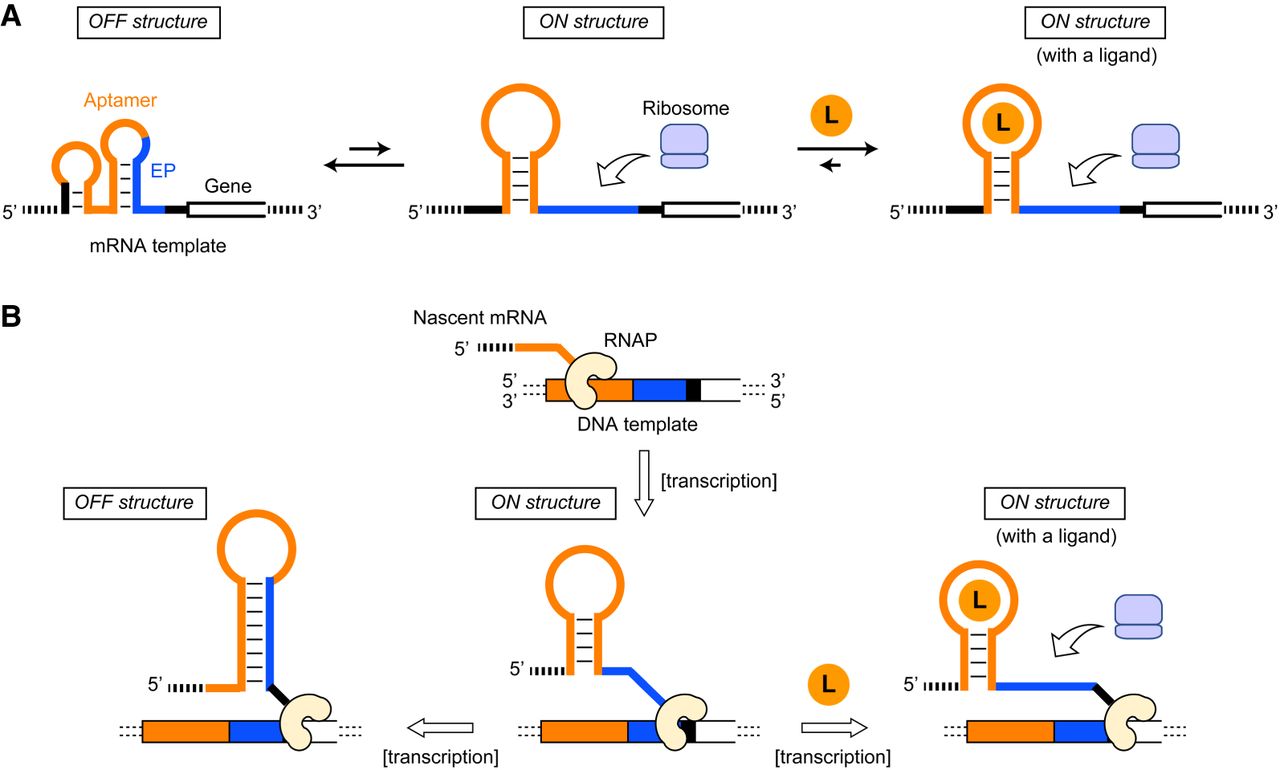
Comparison between an eq-ON-riboswitch and a kt-ON-riboswitch that each regulates translation initiation. (A) Schematic of an eq-ON-riboswitch. Although the inactive OFF structure (left) is more stable than the active ON structure (middle), both structures are in a dynamic equilibrium due to the relatively small ΔΔGTS. Therefore, ligand molecules can shift the equilibrium toward the latter (right). See the energy diagram in Supplemental Figure S1A. (B) Schematic of a kt-ON-riboswitch. This type of riboswitch folds into the ON structure (middle) right after transcription of its aptamer domain. While the reverse transition to the OFF structure takes place rapidly (left) after transcription of the downstream EP (before the ribosome binds to the EP intermolecularly), it is inhibited by stabilization with ligand binding for the subsequent translation (right). Note that the forward transition (i.e., retransition from OFF to ON) is considerably suppressed even in the presence of ligand molecules due to the large ΔΔGTS, which prevents the system from reaching equilibrium. RNAP means RNA polymerase. See the energy diagram in Supplemental Figure S1B.




