


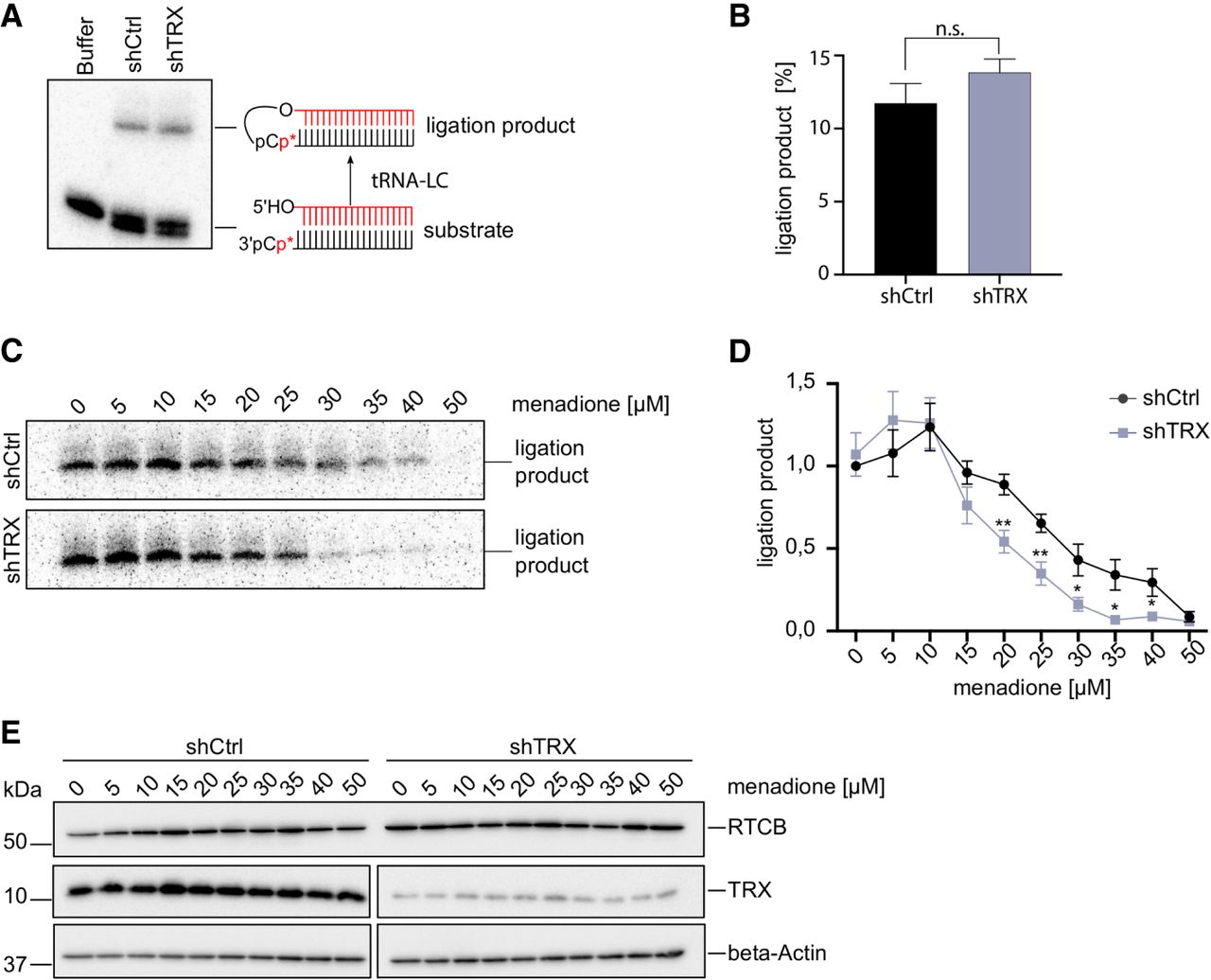
Depletion of TRX by shRNAs sensitizes the tRNA-LC to oxidative stress. (A) HeLa cells expressing a short RNA hairpin (shRNA) targeting TXN mRNA to deplete TRX protein (shTRX), or a control shRNA targeting Renilla luciferase (shCtrl) upon addition of 2 µg/mL Dox, were lysed after 3 d of shRNA expression and RNA ligation activity was assayed by incubating cell lysates with a double-stranded, radiolabeled RNA substrate containing a 3′ phosphate on one strand and a 5′OH on the complementary strand. Products of the reaction were resolved by denaturing urea polyacrylamide gel electrophoresis and visualized by phosphorimaging. (B) Quantification of band intensities from A. The substrate conversion rate was calculated as the quotient of the substrate and the sum of substrate and product band intensities. (n = 7, mean values ± SEM are shown, significances were analyzed using unpaired Student's t-test assuming unequal variances, with [*] P < 0.05; [**] P < 0.01; [***] P < 0.005). (C) ShCtrl and shTRX cells were treated with increasing concentrations of menadione for 1 h before harvest and lysis. Cell lysates were assayed as in A. (D) Quantification of band intensities from C. The substrate conversion rate was calculated as in B, with n = 6. (E) Levels of RTCB and TRX were assessed in shTRX and shCtrl cell lysates after treatment with increasing concentrations of menadione for 1 h by western blot using anti-RTCB and anti-TRX antibodies. Levels of β-Actin were used as a loading control.




