


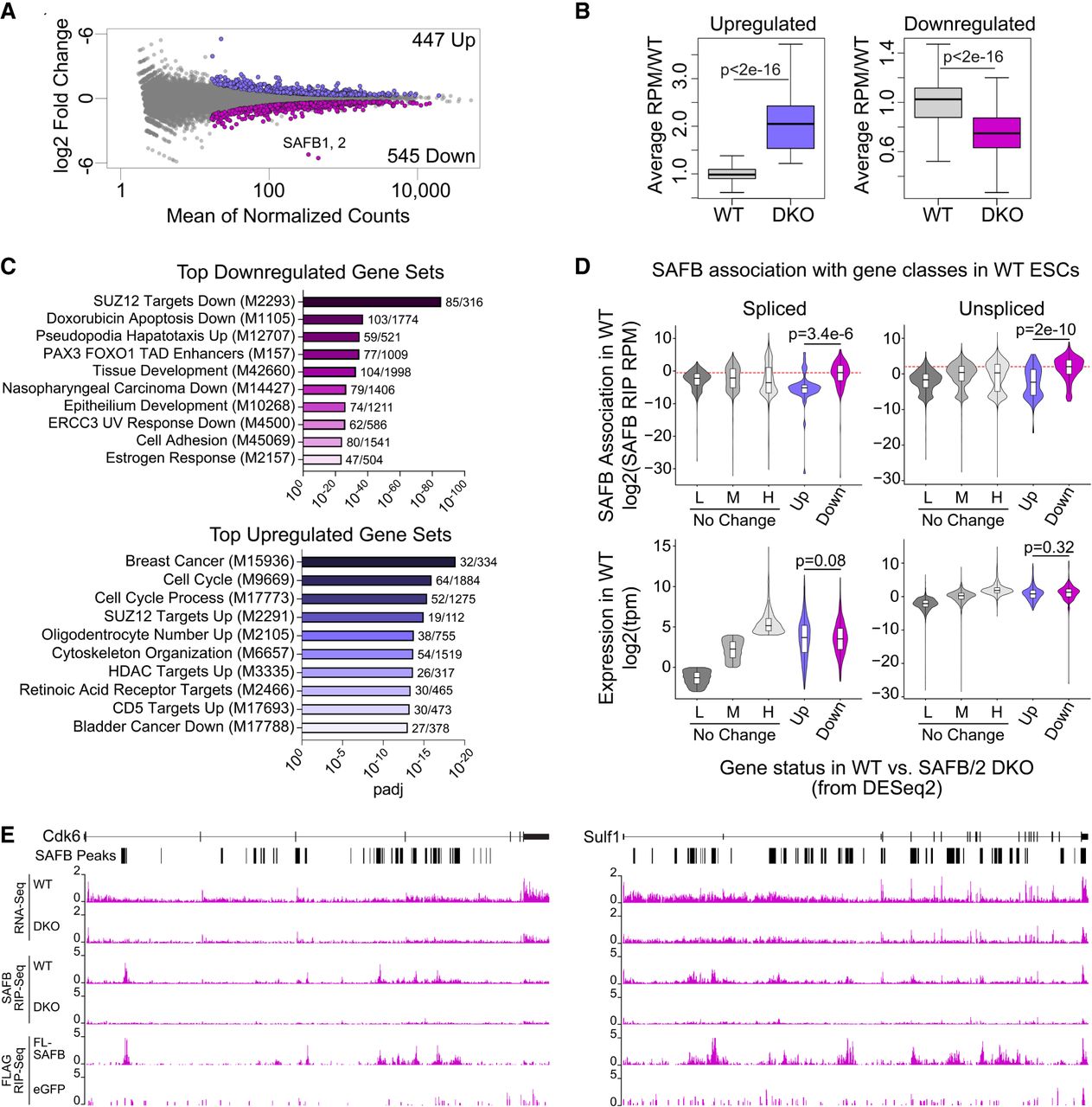
SAFB/2 loss alters the expression of a subset of genes in mouse ESCs. (A) MA plot of differential gene expression between WT and DKO ESCs; purple dots, up-regulated genes, magenta dots, down-regulated genes. (B) Average RPM of up- and down-regulated genes in WT relative to DKO ESCs. P-values, paired t-test. (C) Top 10 enriched gene sets (from molecular signatures database [MSigDB]) (Subramanian et al. 2005; Liberzon et al. 2015) associated with up- and down-regulated genes. (D) SAFB association and overall expression levels of spliced and unspliced transcripts in WT ESCs, broken down by whether genes are up-regulated (Up), down-regulated (Down), or do not change in expression upon SAFB/2 DKO (No Change). The set of nonchanging genes is further partitioned into three categories: those with low (0.125–1 TPM; “L”), medium (>1 but <16 TPM; “M”), and high (>16 TPM; “H”), levels of expression. (E) Representative genes (Cdk6 and Sulf1) that harbor intronic peaks of SAFB association and whose expression drops upon DKO and is restored upon reintroduction of SAFB cDNA.




