


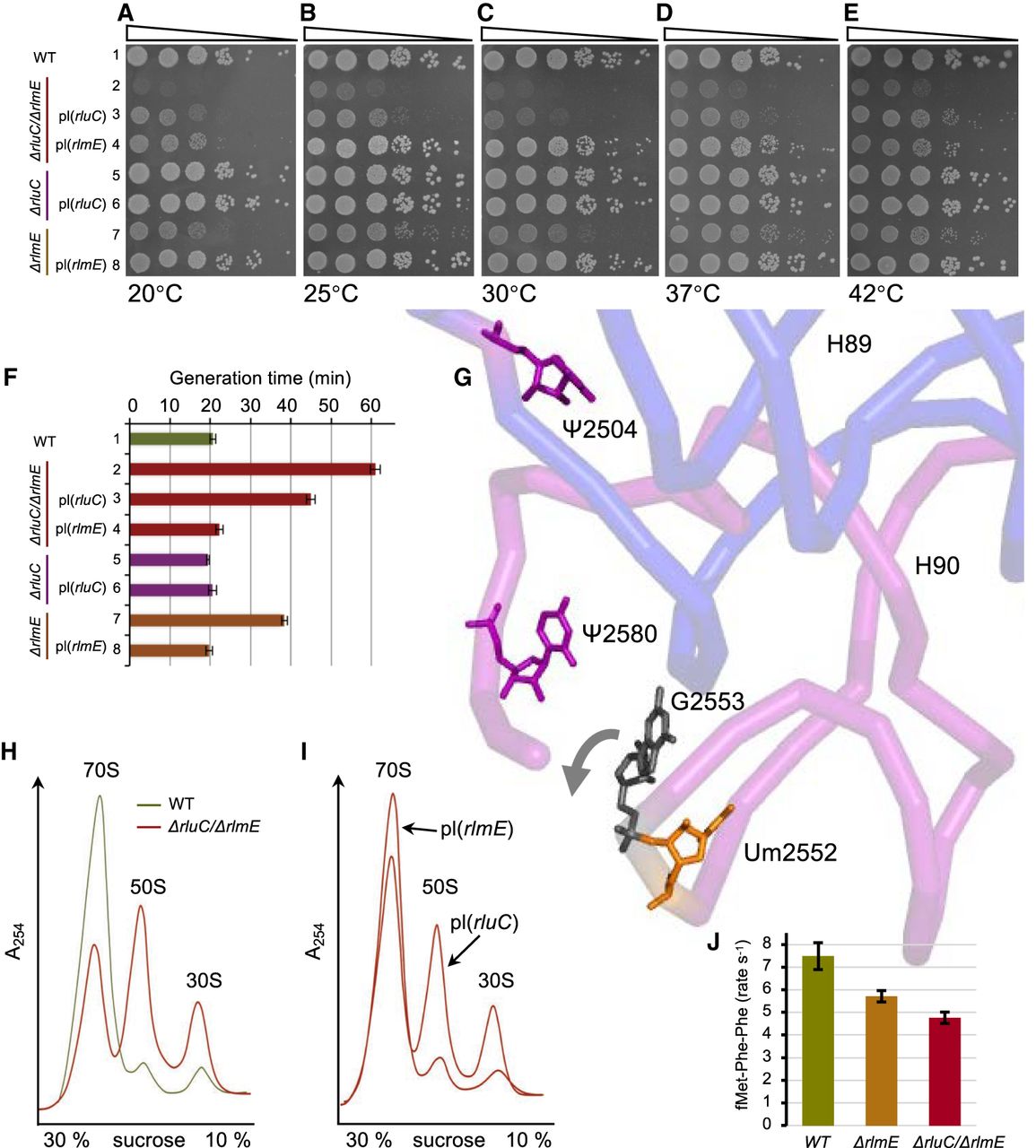
Assays of growth rate, ribosome sucrose gradient profile, and tripeptide synthesis for ΔrluC/ΔrlmE. (A–E) Representative spot growth assays at various temperatures with progressive dilutions of cells on chloramphenicol agar plates (see Materials and Methods). Rescue experiments used plasmids (pl) encoding the genes indicated (in addition to CmR). Rows 1, 2, 5, and 7 carried an empty vector to impart CmR (not indicated), and other controls are in Supplemental Figure S3. (F) Generation times in liquid cultures at 37°C. The control plasmid is not indicated (rows 1, 2, 5, and 7 had the empty vector carrying CmR). Standard errors are from at least seven biological replicates. (G) 3D proximity (Borovinskaya et al. 2007) of two of the three RluC-modified nucleotides (purple), the RlmE-modified nucleotide (orange), and the rRNA nucleotide G2553 (gray) whose relative position is affected the most (arrow) by ΔrlmE (Wang et al. 2020). Part of the nearby backbone, including that of the four nucleotides, is also shown (backbone inside the critical region is blue, outside is purple; see Fig. 1A). (H,I) Ribosome sucrose gradients of unrescued (H) and rescued (I) ΔrluC/ΔrlmE grown according to F. Sedimentation is from right to left, and other sucrose gradients according to F are in Supplemental Figure S4. Representatives of two biological replicates are shown. (J) Rates of tripeptide synthesis at 37°C. WT 7.5 ± 0.59 sec−1, ΔrlmE 5.7 ± 0.25 sec−1, ΔrluC/ΔrlmE 4.8 ± 0.24 sec−1. One-tailed P = 0.0095 for ΔrluC/ΔrlmE vs. ΔrlmE, P = 0.0045 for ΔrluC/ΔrlmE vs. WT; P = 0.015 for ΔrlmE vs. WT.




