


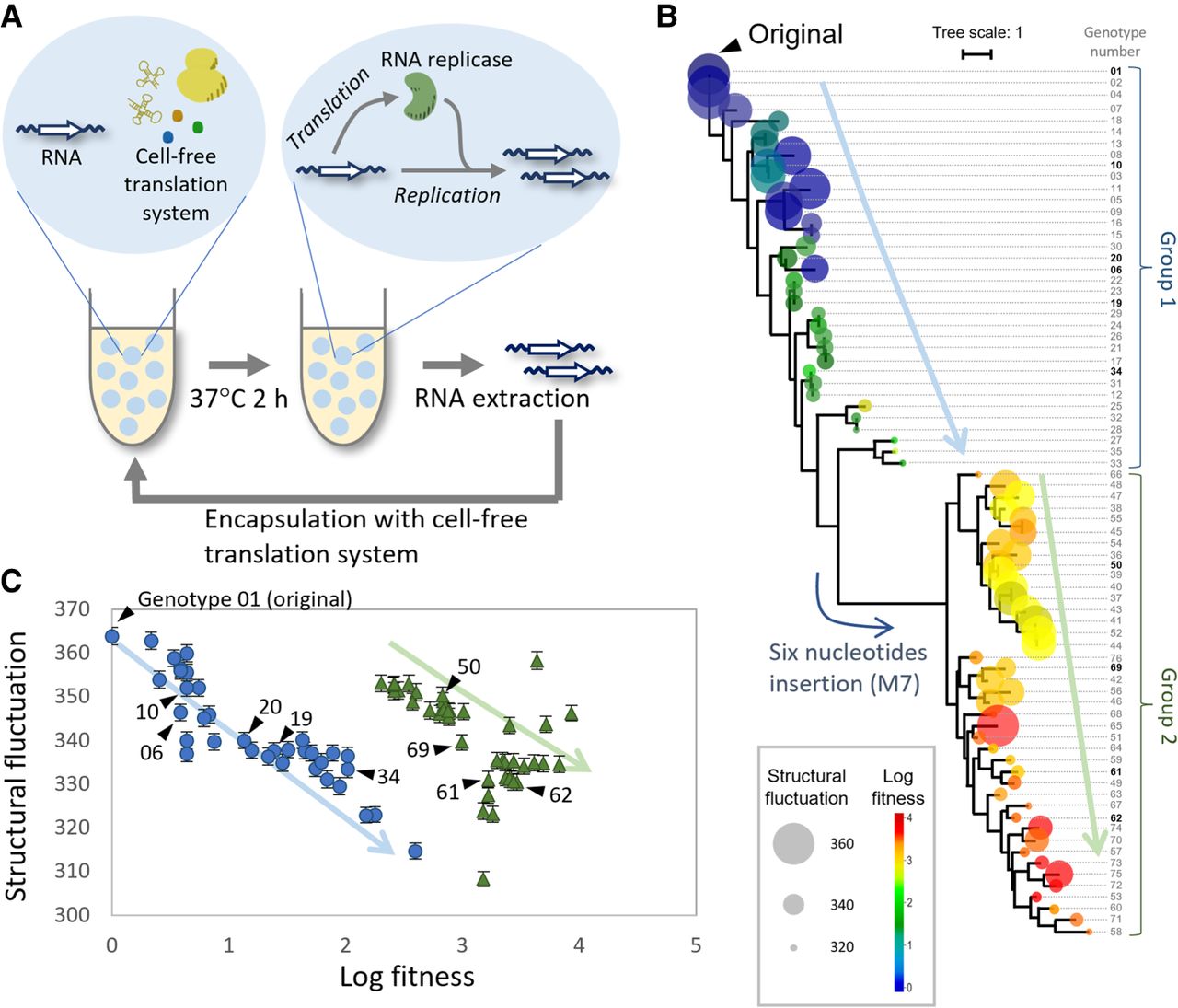
Relationship between sequences, fitness, and the structural (phenotypic) fluctuations of the 76 RNAs used in this study. (A) Scheme of the previous evolutionary experiment of RNA. An RNA that encodes an RNA replicase replicated in a translation-coupled manner in a reconstituted E. coli translation system. When repeating the RNA replication in microscale water-in-oil droplets through the incubation cycle at 37°C for 2 h, RNA extraction, and reencapsulation with the new translation system, the RNA continuously replicated and evolved by introducing mutations through replication error. We analyzed 76 RNA genotypes that appeared during the previous evolution. The fitness (replication ability) of the RNAs increased depending on the structural changes, which affect the ability of the RNA to be replicated. (B) Phylogenetic tree of the 76 genotypes. The color and size of each circle represent the fitness values and the structural fluctuations, respectively. (C) Relationship between the fitness and the structural fluctuations of the 76 genotypes. Genotypes to be analyzed later are indicated. The blue and green arrows represent plausible orders of appearance. The error bars represent the standard error of the Hamming distances (structural fluctuation) (n = 1000).




